Fable 5.2 Returns 400? Fix History, Thinking, and Tool Calls
Diagnose Fable 5.2 upgrade failures, preserve signed history, remove incompatible parameters, and separate Claude API rules from Bedrock exceptions.
 Ofox

If a Fable 5.2 upgrade returns 400, read the full error before changing the prompt. A conversation-binding error needs a history fix; a forced-tool error needs a request change; and a retention-related rejection needs an account-policy decision. Repeating the identical request will not repair any of these.
This diagnostic follows the Fable 5.2 migration documentation, checked November 10, 2026. Examples marked “before” illustrate patterns incompatible with the documented native contract. Our Ofox probes did not reproduce the documented 400 for disabled thinking or forced tools; the route returned 200 instead. The observed results below are important if your gateway accepts a request without enforcing its intended behavior.
What our Ofox probes actually returned
We sent three small requests to https://api.ofox.ai/anthropic/v1/messages using exact ID anthropic/claude-fable-5.2, API version 2023-06-01, low effort, and a 4,096-token cap. All asked for the value of three units at USD 12 and used only synthetic data.
| Probe | Observed response | What it establishes |
|---|---|---|
| Minimal request | 200, end_turn, USD 36 | The basic text case completed |
Add thinking: {"type":"disabled"} | 200, same visible answer | The route accepted the field; this does not establish that thinking was disabled |
Add a declared tool and force lookup_stock | 200, text answer, no tool call | The requested forced execution did not occur in this test |
The forced-tool probe deliberately retained the original prompt’s “Do not use tools” instruction. A forced-selection contract cannot be validated merely by receiving a plausible answer; this response contained no tool_use block. We have not established which gateway or upstream layer handled the incompatible settings, so we do not label them supported or claim to have located the cause.
These are single-request observations, not stable compatibility guarantees. Use the documented contract for portable code, omit incompatible controls, and test the delivered behavior on your exact route. The rest of this article explains the official 400 branches and the application fixes. We did not reproduce signed-prefix, retention, computer-tool, or advisor failures in this small batch.
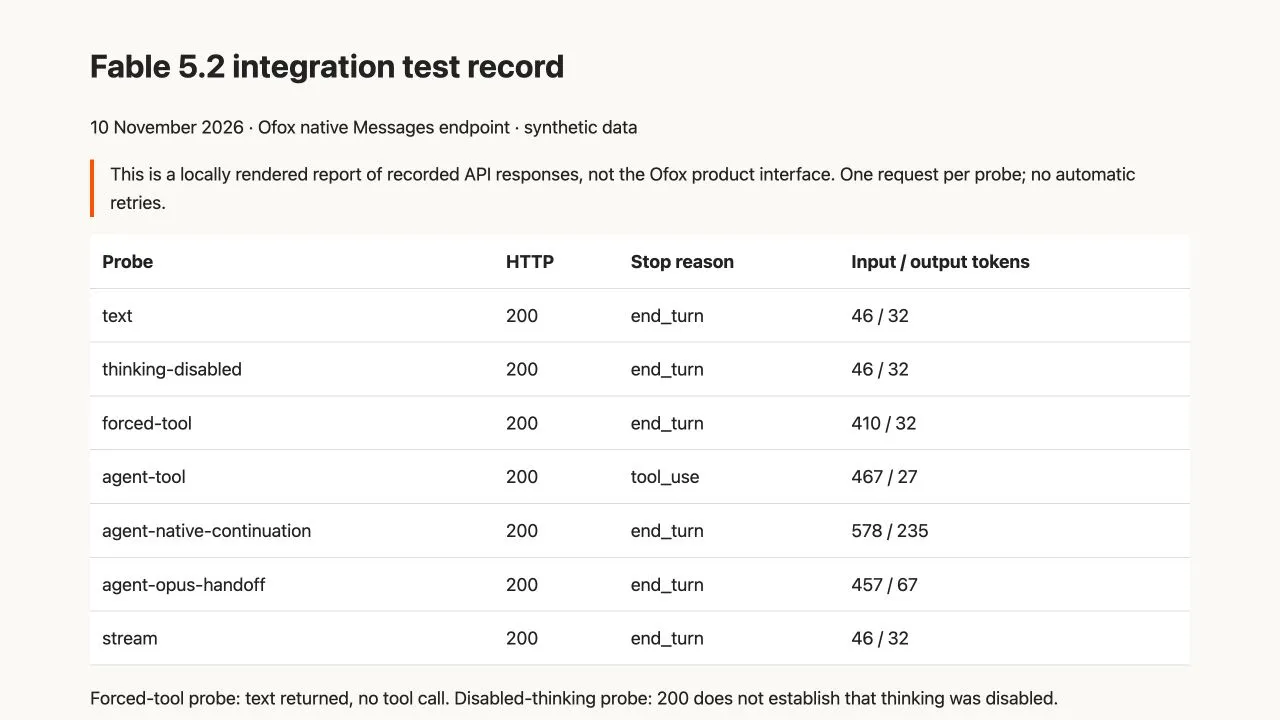
Screenshot of our locally rendered test record, populated from actual API responses. This is not an Ofox product-interface screenshot.
Find the failure boundary first
Record the exact model, endpoint, API version, SDK version, status, error body, and request ID. Then identify the first request that fails. Keep credentials and private conversation content out of public bug reports.
| Failure boundary or error | Inspect first | Appropriate next action |
|---|---|---|
| First request, message names thinking or sampling | Defaults injected by SDK wrapper | Remove incompatible fields |
| Follow-up says a block belongs to another conversation | System, tool definitions, and earlier messages | Restore the original prefix |
Error names tool_choice | Forced selection added by a framework | Use auto; enforce completion in application code |
| Error names an unmatched tool ID | Assistant tool calls and the next tool-result message | Restore every actual matching result |
| Error names computer or advisor tools | Model/platform compatibility | Apply the platform-specific migration |
| First Claude API request names retention or ZDR | Workspace retention eligibility | Resolve with the account owner before sending data |
| HTTP success but no answer text | Stop reason and output allowance | Diagnose output exhaustion, not a 400 |
Preserve one known-good request with synthetic input. Strip optional fields from a copy and add them back one at a time. This makes it possible to distinguish a model restriction from a wrapper silently adding defaults. Keep the original captured request unchanged for comparison.
Repair a conversation-binding failure
Fable 5.2 applies the prefix check to every account. A request that worked on Fable 5.1 through an older account can fail after the upgrade if your client edits earlier history. The documented message includes The block is bound to a different conversation.
Typical causes include rebuilding the system prompt with a new timestamp, changing the tool schema between turns, reordering messages, or replacing earlier content with a local summary. An unchanged signature alone does not make an edited prefix valid.
Here is the difference at the application level:
# Before: rewriting history after the model has produced signed content.
system = base_system + " Current time: " + current_timestamp
messages[0] = {"role": "user", "content": shortened_original_request}

# After: freeze the original request prefix; add genuinely new instructions.
system = original_system
messages.append({"role": "user", "content": new_instruction})
The “after” pattern is for new information, not a universal way to compact a full context window. If you must change the task, tools, or summary, start a fresh conversation using a verified application checkpoint, or use a documented context-management mechanism supported on your route. Do not keep old signed blocks and simply hope the edited history is equivalent.
Compare serialized values at the boundary immediately before sending. Check the original system prompt, tool definitions, message order, and complete assistant blocks. A human-readable chat log may omit the exact fields that matter. For MCP integrations, also inspect whether a changing server tool list alters the prefix; pinning only your local tool dictionary may not cover that source of change.
The preserved-thinking guide documents a recovery beta with thinking.block_binding.prefix_mismatch_behavior: "drop_block" and the thinking-binding-controls-2026-08-01 header. It drops affected reasoning rather than repairing it. Use its input_transformations report to find the edit, and account for possible extra regeneration. Verify beta support on the selected route before depending on it; this article does not claim the Ofox Bedrock path passes through that control.
Keep whole assistant messages, including opaque blocks
Do not reconstruct the next request from only text shown in a UI. Native thinking blocks have opaque signatures, and redacted blocks contain opaque data. Preserve the complete response blocks and their order when continuing the same conversation.
# response is a completed native SDK Message.
messages.append({
    "role": "assistant",
    "content": [block.model_dump(exclude_none=True)
                for block in response.content],
})
With streaming, wait for completion and obtain the assembled final message. A collector that records only text deltas can display a useful answer while saving an unusable continuation. Never create a replacement signature. If state was lost, recover the original message or start a new task session from verified facts.
An “invalid signature” error and a “different conversation” error are related diagnostics, not identical causes. The existing Claude thinking-signature article covers serialization and streaming mistakes. This 5.2 guide adds the stricter upgrade boundary; it does not imply that every historical model has the same enforcement rules.
Remove inherited thinking and sampling settings
Fable 5.2’s adaptive thinking cannot be disabled. A wrapper carried over from a model with manual thinking may send a fixed budget_tokens or thinking: {"type":"disabled"}. Remove those settings and use the supported effort control.
{
  "model": "claude-fable-5-2",
  "max_tokens": 4096,
  "output_config": {"effort": "low"},
  "messages": [{"role": "user", "content": "Calculate 3 times 12."}]
}
This is a Claude API request-body template. On Ofox use the ID and endpoint from the API guide. It omits thinking because adaptive behavior is already the model default.
Remove temperature, top_p, and top_k rather than trying random values. The thinking compatibility reference distinguishes API versions: for these newer models, non-default sampling values are rejected under older versions; from API version 2026-10-21, including those fields at any value is rejected. Also check for a prefilled final assistant message, which is not a supported workaround for output formatting here.
Always-on thinking and forced-tool restrictions also apply to Fable 5.1. They are inherited constraints that an upgrade can expose through changed code paths, not all newly introduced 5.2 rules.
Replace forced tool selection without pretending execution is guaranteed
Under the documented native Claude contract, these patterns are incompatible with Fable 5.2. As the Ofox probes above show, do not assume every gateway returns the same error:
{"tool_choice": {"type": "any"}}{"tool_choice": {"type": "tool", "name": "lookup_stock"}}Use {"tool_choice":{"type":"auto"}} and describe when the lookup is necessary. Then validate the actual response. If the task requires authoritative inventory data but the model answers without calling the tool, do not accept that answer as completed inventory work.
For schema-shaped output, supported strict tool schemas or structured output can address format requirements. They do not mean a particular tool must run, and model/account restrictions still apply. In particular, the official migration guide identifies customer-managed encryption-key organizations as a case requiring additional structured-output compatibility checks.
A safe application loop separates three decisions: whether a tool call was requested, whether its arguments are valid and authorized, and whether its result satisfies the task. It should have a bounded number of turns and an explicit failed/incomplete state. Otherwise, replacing forced selection with auto can turn a visible 400 into an invisible missing action.
Repair missing tool results at the protocol layer
If the error names tool_use_id, list all tool calls in the preceding assistant turn and pair every one with its actual result. Use the native user-message tool_result shape for Anthropic messages and the tool-message shape for Chat Completions. They are different protocols.
For a failed lookup, return a truthful error result. For a lookup that succeeded before a process crash, retrieve the durable recorded result. Do not rerun a payment, email, or write operation merely to obtain a new tool-result block. The tool-result 400 diagnostic explains message placement; the checkpoint tutorial explains the durable record needed across restarts.
Check the Bedrock and advisor exceptions
The old computer_20251124 tool returns an error with Fable 5.2 on the documented platforms except Amazon Bedrock. Elsewhere, migration requires the newer computer_toolset_20260801 declaration and corresponding agent-loop changes, not just changing the type string while retaining old arguments.
This exception matters for Ofox: the November 10 catalog lists aws_bedrock for Fable 5.2. Do not report the old computer tool as an observed Ofox failure based only on a Claude API example. Confirm the actual route, supported tool surface, and full request first.
If using Anthropic’s advisor tool, a 5.2 executor needs a supported 5.2 advisor. Changing the advisor declaration changes the tool prefix, so migrate in a new conversation rather than editing an existing signed session. The advisor beta is another feature whose availability should be checked separately from ordinary text and function calling.
Do not treat policy or capacity failures as malformed prompts
Anthropic documents a 30-day retention requirement for Fable 5.2, with exceptions requiring express authorization. A Claude API workspace running under incompatible ZDR settings can receive a 400. Do not automatically weaken a customer’s retention policy to make a request succeed. Route this decision to the account owner and consult the actual platform’s terms; the rule is not evidence of Ofox’s account configuration.
For 429 or 529, inspect capacity and retry guidance instead. Retrying with bounded backoff may be appropriate for transient overload, while retrying a malformed 400 unchanged is not. Use the 529 overload guide and current Ofox rate-limit documentation.
Verify the fix with the same failing workflow
Run a fresh request, a follow-up, a read-only tool round trip, and a saved-session restore. A fresh request passing does not prove that history preservation is fixed. In a separate synthetic test, deliberately edit a prefix to confirm that your diagnostic identifies the transformation rather than masking it.
Keep the before/after request shape, error, exact route, and completion result. If you enabled a block-dropping recovery, record dropped state and inspect the delivered answer too. End the investigation only when the real workflow completes its independent acceptance checks without replaying side effects.
Related docs: Ofox native Messages, authentication, and the official migration guide.