Claude Haiku 4.5 vs GPT-5.4 Mini (2026): $1 vs $0.75/M — Who Wins?
Claude Haiku 4.5 ($1/$5 per M) vs GPT-5.4 Mini ($0.75/$4.50): GPT wins on price and speed, Haiku on code quality. Route both to cut API costs 60–70%.
 Ofox
Ofox 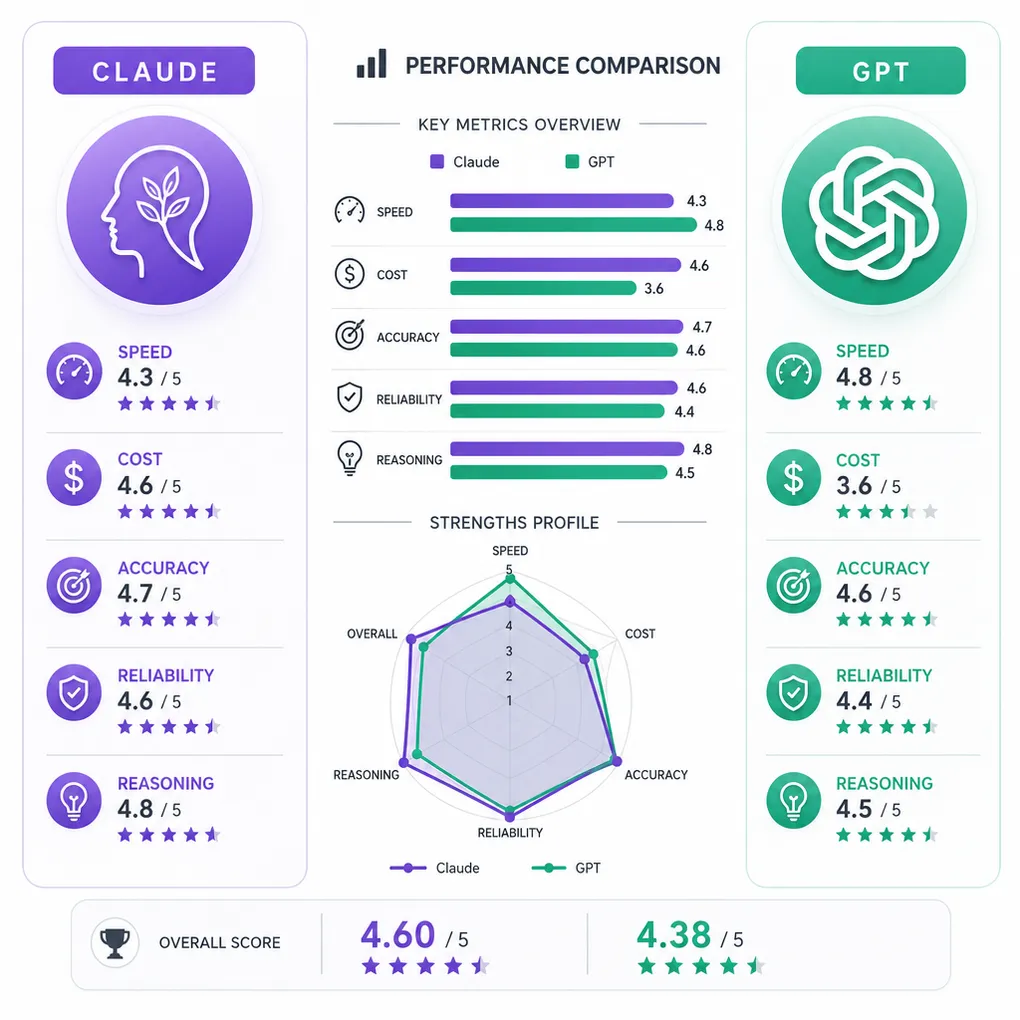
TL;DR — Claude Haiku 4.5 and GPT-5.4 Mini are the two best budget AI models in 2026, each costing 80-90% less than flagship models. GPT-5.4 Mini wins on price and speed; Claude Haiku 4.5 wins on instruction-following and code quality. For most production workloads, routing simple tasks to GPT-5.4 Mini and complex tasks to Claude Haiku 4.5 cuts API costs by 60-70% without noticeable quality loss.
Why Budget Models Matter in 2026
A year ago, budget AI models were afterthoughts. Developers tolerated them for classification tasks and nothing else. The quality gap between budget and flagship models was too wide to trust them with anything important.
That gap has closed dramatically. Claude Haiku 4.5 and GPT-5.4 Mini now handle tasks that required Claude Opus or GPT-5.4 six months ago — at a fraction of the cost. For startups burning through API budgets and enterprises processing billions of tokens monthly, this shift changes the economics of AI deployment.
The question is no longer “can I use a budget model?” It’s “which budget model, and for what?”
The Contenders: Specs and Pricing
| Metric | Claude Haiku 4.5 | GPT-5.4 Mini |
|---|---|---|
| Provider | Anthropic | OpenAI |
| Context Window | 200K tokens | 400K tokens |
| Input Cost | ~$1.00/M tokens | ~$0.75/M tokens |
| Output Cost | ~$5.00/M tokens | ~$4.50/M tokens |
| Speed | Fast | Faster |
| Strengths | Instruction-following, code quality | Speed, structured output, price, long context |
| Best For | Complex logic, multi-step tasks | High-volume classification, extraction, long documents |
Pricing shown is approximate via ofox.ai — actual rates vary by provider and volume. Both models are accessible through a single API endpoint using the OpenAI SDK format.
Head-to-Head: Where Each Model Wins
Code Generation
Winner: Claude Haiku 4.5 (by a narrow margin)
Ask both models to write a Python function that validates email addresses with specific business rules — must be from approved domains, handle internationalized addresses, log validation failures to a specific format.
Claude Haiku 4.5 produces code that follows all constraints, handles edge cases, and includes appropriate error messages. GPT-5.4 Mini generates working code but occasionally misses one of the constraints or produces overly generic error handling.
For simple CRUD operations, utility functions, or boilerplate code, the difference is negligible. For business logic with multiple constraints, Claude Haiku 4.5’s instruction-following advantage shows up consistently.
Example task: Generate a TypeScript function that fetches paginated API results, retries on rate limits, and aggregates results into a single array.
// Claude Haiku 4.5 output: includes retry logic, respects rate limits, proper typing
async function fetchAllPages<T>(
  baseUrl: string,
  options: { maxRetries?: number; retryDelay?: number } = {}
): Promise<T[]> {
  const { maxRetries = 3, retryDelay = 1000 } = options;
  const results: T[] = [];
  let page = 1;

  while (true) {
    const response = await fetchWithRetry(
      `${baseUrl}?page=${page}`,
      maxRetries,
      retryDelay
    );

    if (!response.data.length) break;
    results.push(...response.data);
    page++;
  }

  return results;
}
GPT-5.4 Mini produces similar code but occasionally omits the retry delay parameter or uses less precise TypeScript types.
When to use GPT-5.4 Mini instead: Generating test fixtures, scaffolding REST endpoints, writing SQL queries from natural language descriptions. Tasks where the structure is predictable and constraints are minimal.
Structured Output and JSON Generation
Winner: GPT-5.4 Mini
When you need reliable JSON output — extracting structured data from text, generating API payloads, formatting responses for downstream systems — GPT-5.4 Mini is more consistent.
Feed both models a job posting and ask them to extract company name, location, salary range, required skills, and application deadline into a JSON schema. GPT-5.4 Mini consistently produces valid JSON on the first try. Claude Haiku 4.5 occasionally wraps the JSON in markdown code fences or adds explanatory text outside the JSON object, requiring post-processing.
OpenAI’s structured output mode (available in GPT-5.4 Mini) guarantees schema-compliant JSON, which matters enormously for production pipelines where malformed output breaks downstream systems.
When to use Claude Haiku 4.5 instead: When the extraction task requires reasoning about ambiguous or contradictory information. Claude Haiku 4.5 is better at resolving conflicts in source data and making judgment calls about what to include.
Summarization and Content Rewriting
Winner: Claude Haiku 4.5
Claude Haiku 4.5 produces summaries that preserve nuance and capture the author’s intent. GPT-5.4 Mini summaries are competent but tend toward generic phrasing and miss subtle points.
Give both models a 3,000-word technical article and ask for a 200-word summary. Claude Haiku 4.5’s output reads like a human wrote it — varied sentence structure, appropriate emphasis on key points, natural transitions. GPT-5.4 Mini’s summary hits the main points but feels more mechanical.
For customer support ticket summarization, meeting notes, or content moderation decisions where context matters, Claude Haiku 4.5’s edge in reading comprehension translates to better results.
When to use GPT-5.4 Mini instead: High-volume summarization where speed matters more than perfect quality — news aggregation, social media monitoring, log file summarization. GPT-5.4 Mini’s speed advantage compounds when processing thousands of documents per hour.
Classification and Sentiment Analysis
Winner: GPT-5.4 Mini
For binary or multi-class classification tasks — spam detection, sentiment analysis, intent recognition, content tagging — GPT-5.4 Mini is faster and cheaper with no meaningful quality difference.
Both models achieve high accuracy on standard classification benchmarks. GPT-5.4 Mini’s speed advantage means it processes classification requests noticeably faster, which matters when you’re classifying millions of customer messages or social media posts.
When to use Claude Haiku 4.5 instead: When classification requires understanding subtle context or when the categories are ambiguous. For example, classifying customer feedback as “bug report” vs “feature request” vs “usage question” when the message contains elements of all three. Claude Haiku 4.5 makes better judgment calls in gray areas.
Long-Context Tasks
Winner: GPT-5.4 Mini
GPT-5.4 Mini’s 400K token context window vs Claude Haiku 4.5’s 200K tokens is a significant advantage for tasks like:
- Analyzing entire codebases (medium to large projects)
- Processing very long legal documents or research papers
- Maintaining extensive conversation history in multi-turn chat applications
- Comparing multiple large documents side-by-side
For applications where you need to fit substantial context into a single request, GPT-5.4 Mini’s larger window reduces the need for chunking and re-prompting, which improves both quality and total cost.
When to use Claude Haiku 4.5 instead: When your context fits comfortably under 150K tokens and you need better instruction-following or code quality. The context window advantage doesn’t matter if you’re not using it.
Real-World Cost Comparison
Let’s model a realistic production workload: a customer support AI that processes 10 million input tokens and generates 2 million output tokens per month.
Claude Haiku 4.5:
- Input: 10M × $1.00 = $10,000
- Output: 2M × $5.00 = $10,000
- Total: $20,000/month
GPT-5.4 Mini:
- Input: 10M × $0.75 = $7,500
- Output: 2M × $4.50 = $9,000
- Total: $16,500/month
GPT-5.4 Mini saves $3,500/month (17.5%) on this workload. Scale that to 100M tokens/month and the difference is $35,000/month — a meaningful cost reduction for high-volume applications.
The routing strategy: Use GPT-5.4 Mini for 70% of requests (simple questions, classification, extraction) and Claude Haiku 4.5 for 30% (complex questions, multi-step reasoning). This hybrid approach costs approximately $17,500/month — a 12.5% savings vs Claude Haiku 4.5 alone, while maintaining quality where it matters.
For a detailed guide on cost optimization strategies, see our how to reduce AI API costs article.
When to Use Each Model
Use Claude Haiku 4.5 when:
- Code generation with multiple business constraints
- Summarizing nuanced content (legal docs, research papers, customer feedback)
- Multi-step reasoning tasks where instruction-following matters
- Writing quality matters (customer-facing content, documentation)
- Context requirements are under 150K tokens
Use GPT-5.4 Mini when:
- High-volume classification or sentiment analysis
- Structured data extraction into JSON
- Speed-critical applications (real-time chat, autocomplete)
- Simple code generation (boilerplate, CRUD, SQL queries)
- Long-context tasks requiring 200K+ tokens
- Cost is the primary constraint
Use both (model routing):
The winning strategy for most production systems is routing requests dynamically based on complexity. Simple requests go to GPT-5.4 Mini; complex requests escalate to Claude Haiku 4.5 (or even Claude Opus 4.6 for the hardest problems).
This requires an API layer that supports multiple models through a single interface. Platforms like ofox.ai provide exactly this — one API key, one endpoint, 100+ models including both Claude Haiku 4.5 and GPT-5.4 Mini. You can implement routing logic in your application code without managing multiple API integrations.
For more on model selection strategies, see our Claude vs GPT vs Gemini comparison guide.
How to Switch Between Models Without Rewriting Code
Both Claude Haiku 4.5 and GPT-5.4 Mini are accessible through OpenAI-compatible APIs, which means you can use the official OpenAI SDK and switch models by changing a single parameter.
Example using the OpenAI Python SDK via ofox.ai:
from openai import OpenAI

client = OpenAI(
    api_key="sk-your-ofox-api-key",
    base_url="https://api.ofox.ai/v1"
)

# Use GPT-5.4 Mini for simple classification
response = client.chat.completions.create(
    model="openai/gpt-5.4-mini",
    messages=[{"role": "user", "content": "Classify this email as spam or not spam: ..."}]
)

# Use Claude Haiku 4.5 for complex reasoning
response = client.chat.completions.create(
    model="anthropic/claude-haiku-4.5",
    messages=[{"role": "user", "content": "Analyze this contract and extract key obligations: ..."}]
)
No SDK changes. No authentication changes. Just swap the model identifier. This makes A/B testing trivial and lets you implement dynamic routing without architectural complexity.
For a complete migration guide, see our OpenAI SDK migration to ofox.ai tutorial.
The Verdict: Which Budget Model Should You Use?
There is no universal winner. The right choice depends on your workload:
Choose Claude Haiku 4.5 if:
- Quality matters more than cost (but you still need to stay under budget)
- Your tasks involve complex instructions or multi-step reasoning
- You’re processing documents under 150K tokens
- Writing quality is customer-facing
Choose GPT-5.4 Mini if:
- Cost and speed are primary constraints
- You’re processing high volumes of simple tasks (classification, extraction)
- You need reliable structured output (JSON, function calling)
- You need large context windows (200K-400K tokens)
Choose both (model routing) if:
- You have a mix of simple and complex tasks
- You want to optimize cost without sacrificing quality on hard problems
- You’re willing to implement routing logic in your application
Next Steps
Ready to test both models in your application? Here’s how to get started:
- Sign up for ofox.ai — get one API key that works with both Claude Haiku 4.5 and GPT-5.4 Mini (plus 100+ other models)
- Run A/B tests — send the same prompts to both models and compare quality, speed, and cost on your actual workload
- Implement routing — start with a simple rule (e.g., requests under 500 tokens go to GPT-5.4 Mini, longer requests go to Claude Haiku 4.5)
- Monitor and optimize — track which model performs better on which task types and refine your routing logic over time
For more on building cost-efficient AI systems, check out our guides on AI API aggregation and best AI models for coding.