OpenRouter Kimi K3 429 Errors? Fail Over in 2 Minutes (2026)
OpenRouter flags Kimi K3 with a 'frequent 429' capacity warning. The fix: back off, then fail over to GLM-5.2 or DeepSeek V4 on one endpoint.
 Ofox
Ofox 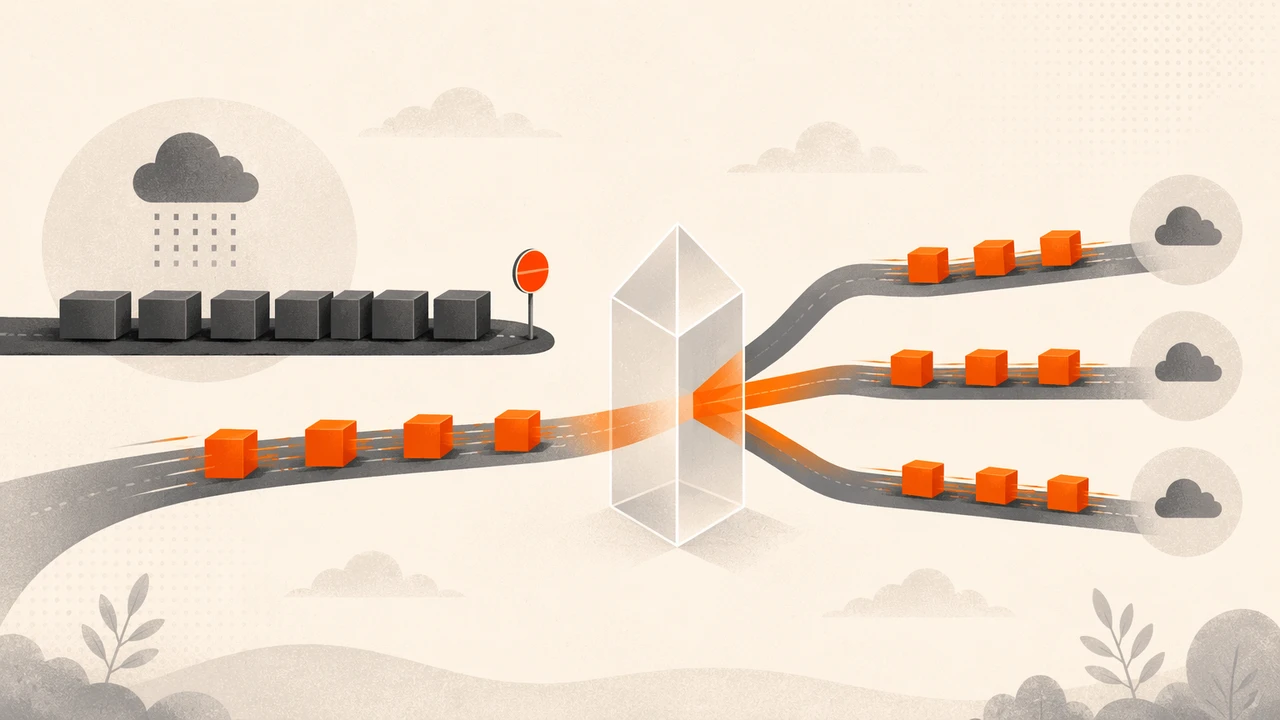
TL;DR. If your OpenRouter calls to Kimi K3 keep returning 429, it is not your code and not your quota. Moonshot’s upstream capacity for K3 is limited at launch, and OpenRouter says so on the model page itself: “Upstream capacity is currently limited. This model may return frequent 429 errors.” K3 there is a single-provider route, so there is no provider to fail over to. The fix is two layers: back off for the first couple of retries, then fail over to a comparable model — GLM-5.2 or DeepSeek V4 — on one endpoint and one key. No gateway, ofox included, makes the upstream 429 disappear; a gateway just makes the hop to a backup a config line instead of a rewrite.
A 429 on K3 is the upstream saying “no room,” not your account saying “too much.” Retrying the same route harder queues you behind everyone else doing exactly that. The only move that works is a different model.
Is It K3, OpenRouter, or You? The 30-Second Check
Three checks, in order. If the first two confirm the issue is upstream, stop reading your own logs and jump to the fix.
| Step | What to check | Confirms an upstream 429 if |
|---|---|---|
| 1 | The error body | Status is 429 with a message like rate limited upstream or provider returned error, not an auth or request-shape error |
| 2 | The OpenRouter Kimi K3 page | It shows the banner “Upstream capacity is currently limited. This model may return frequent 429 errors.” |
| 3 | Your own request log | The 429 rate on K3 spiked with no deploy on your side, and other models on the same key are answering fine |
If steps 1 and 2 light up, this is Moonshot capacity, not a bug in your application. Indie developer @levelsio hit exactly this: OpenRouter “immediately said ‘rate limited upstream’,” so he paid Moonshot $19 for a direct key and moved on. You do not have to — but you do need a fallback.
Why K3 429s on OpenRouter Specifically
Two facts stack up.
First, K3 is new and Moonshot is rationing capacity. That is an upstream reality every reseller inherits; it is why OpenRouter, ofox, and a direct Moonshot key can all return 429 on the same afternoon.
Second, and this is the OpenRouter-specific part: the K3 listing is served by one provider. OpenRouter’s page states it plainly — “This model is hosted by one provider. OpenRouter forwards every request to it directly — no routing decisions to make.” OpenRouter’s normal strength is provider routing: when a model has several hosts, it shifts traffic to a healthy one. With a single-provider model there is nothing to shift to. Provider routing cannot save a route that has only one provider.
You can still add a cross-model fallback array yourself on OpenRouter, and you should. The point is that it is not automatic for K3, and the moment you are writing a fallback list you are doing the same work a unified gateway does for you in one place. That is the whole decision this post is about.
The Fix, in Two Honest Layers
Layer 1 — Back off, briefly
Capacity 429s are often transient. Retry the first two or three attempts with exponential backoff and jitter, then stop. The jitter matters: without it, every client that got a 429 at the same instant retries at the same instant and you re-create the stampede.
import time, random, httpx

def backoff_sleep(attempt: int) -> None:
    base = 2 ** attempt          # 1s, 2s, 4s
    time.sleep(base + random.uniform(0, base * 0.3))  # +0–30% jitter
Give up after three tries. A fourth retry on a capacity-limited single-provider route does not find capacity that the first three did not — it just adds to the queue.
Layer 2 — Fail over to a different model
This is the layer that actually recovers the request. When K3 is out of room, the fastest path to an answer is a comparable model that is not. On ofox, K3 and its backups sit behind one OpenAI-compatible endpoint and one key, so the fallback chain is a short loop rather than three integrations:
import os, httpx, time, random

OFOX = "https://api.ofox.ai/v1/chat/completions"
OFOX_API_KEY = os.environ["OFOX_API_KEY"]
HEADERS = {"Authorization": f"Bearer {OFOX_API_KEY}", "Content-Type": "application/json"}

# Primary first, then same-tier backups on separate upstreams.
CHAIN = ["moonshotai/kimi-k3", "z-ai/glm-5.2", "deepseek/deepseek-v4-pro-0813"]

def complete(messages, chain=CHAIN):
    for model in chain:
        for attempt in range(3):
            r = httpx.post(OFOX, headers=HEADERS,
                           json={"model": model, "messages": messages}, timeout=60)
            if r.status_code == 429:
                if attempt == 2:
                    break         # third 429 -> fail over now, don't sleep
                base = 2 ** attempt
                time.sleep(base + random.uniform(0, base * 0.3))
                continue          # retry same model, up to 3x
            r.raise_for_status()
            return model, r.json()
        # three 429s on this model -> drop to the next model in the chain
    raise RuntimeError("all models in the fallback chain are capacity-limited")
The same shape works from Node, or from the OpenAI SDK by pointing base_url at https://api.ofox.ai/v1 and swapping the model string. Nothing about your prompts or message format changes.
The honest part, stated once more so no one ships a false claim internally: the K3 429 comes from Moonshot’s upstream, so no gateway prevents it — ofox included. ofox serves K3 from the same source and will return 429 when Moonshot is full. What changes is recovery time: the failover above turns a hard error into a hop to GLM-5.2 that your users never see.
Pick a Backup That Actually Matches K3
Do not fail over to a model that cannot do the job. For K3’s usual coding and agentic workloads, these are the same-tier substitutes on ofox, by model ID:
| Backup | Model ID | Why it fits |
|---|---|---|
| GLM-5.2 | z-ai/glm-5.2 | Open-weight, 1M context, strong on coding and tool use — closest all-round K3 substitute |
| DeepSeek V4 Pro | deepseek/deepseek-v4-pro-0813 | Deep reasoning and long-context coding; V4 Flash (deepseek/deepseek-v4-flash-0731) is the cheaper, faster tier for drafts |
| Kimi K2.7 Code | moonshotai/kimi-k2.7-code | Shares K3’s Moonshot lineage; lighter and code-focused, a natural degrade for coding tasks |
Confirm current per-token pricing on each model’s page before you wire it into a pipeline — tiers and rates move, and a backup you picked on price three months ago may not be the cheapest today. If you are choosing a gateway rather than a single model, our OpenRouter alternatives comparison and the OpenRouter pricing breakdown cover the fee math, and Is OpenRouter Reliable? covers the uptime side.
Do You Even Need K3 Right Now?
A quick decision frame before you fight the 429:
- You specifically need K3’s capabilities. Keep it as primary, budget a 5–7 second retry window, and fail over on exhaustion. Log the first-try success rate so you can tell when the capacity warning lifts.
- The task is general coding or agentic work. A backup like GLM-5.2 or DeepSeek V4 Pro may serve you fine today with none of the 429s. Promote it to primary and keep K3 as an option for when capacity frees up.
- You have a hard latency SLO. Demote K3 to the backup slot outright. A model with a standing “frequent 429” warning is not a safe default for a path that cannot absorb retries.
The broader pattern here — spike detection, a bounded retry budget, then cross-model failover — is the same one that handles any provider overload. We wrote it up for the Anthropic side in the Claude API error 529 failover guide, and the general version lives in the AI API error handling guide.
One Key for K3 and Its Backups
The reason a gateway helps here is narrow and real: not that it removes the 429, but that it collapses “K3 plus three backups” into one endpoint, one key, and one fallback list. On ofox that means K3 (moonshotai/kimi-k3) and GLM-5.2, DeepSeek V4, and Kimi K2.7 Code all answer on the same OpenAI-compatible API, with no credit-purchase fee and no waitlist to get in. When Moonshot’s capacity warning lifts, you change nothing; when it tightens again, your fallback already caught it.
OpenRouter documents eight status codes and sends Retry-After on two of them. LLM API error codes puts that next to the four other providers.
Frequently Asked Questions
- Why is Kimi K3 returning 429 on OpenRouter?
- Because Moonshot's upstream capacity for K3 is constrained at launch, and OpenRouter's K3 route is served by a single provider with no failover. OpenRouter's own model page carries the notice: 'Upstream capacity is currently limited. This model may return frequent 429 errors.' A 429 here is not your account being throttled for spending too much — it is the upstream saying it has no room right now, so retrying the same route harder just queues you behind everyone else doing the same thing.
- Is the OpenRouter Kimi K3 429 my fault or theirs?
- Neither, in the usual sense. It is upstream: Moonshot is capacity-limited on K3 at launch. It is not a bug in your code and not a per-account rate limit you can pay your way out of. The one thing on your side is the fix — a retry budget plus a fallback to a different model. On OpenRouter, K3 is a single-provider model, so provider-level routing cannot help; you have to fall back to a different model yourself.
- Does switching to ofox make the Kimi K3 429 go away?
- No, and any vendor that claims otherwise is misleading you. ofox serves K3 from the same Moonshot upstream, so it inherits the same capacity crunch — the 429 comes from Moonshot, not the gateway. What a gateway buys you is a fast, one-config fallback: with one key and one endpoint you write kimi-k3 → glm-5.2 → deepseek-v4-pro once, and a K3 429 degrades to a comparable model instead of a failed request. The value is graceful failover, not magic K3 capacity.
- What is a good backup model for Kimi K3?
- For coding and agentic work, GLM-5.2 (z-ai/glm-5.2, open weights, 1M context) and DeepSeek V4 Pro (deepseek/deepseek-v4-pro-0813) are the closest same-tier substitutes, with Kimi K2.7 Code (moonshotai/kimi-k2.7-code) as a lighter option that shares K3's lineage. The right backup depends on your workload — match on context length and task type, then confirm current pricing on the model page before you commit a pipeline.
- Should I retry the 429 or fail over immediately?
- Retry the first two or three attempts with exponential backoff plus jitter (1s, 2s, 4s with a random offset). Capacity 429s can clear in seconds. If the third attempt still returns 429, fail over to your backup model rather than retrying K3 a fourth time — past that point you are just adding load to a route that already has none to give.
- Can I keep using Kimi K3 in production while it is capacity-limited?
- Yes, if you treat it as a best-effort primary with a real fallback, not a guaranteed one. Set a short retry budget (roughly 5–7 seconds), fail over on exhaustion, and log how often K3 answers on the first try so you can see when the capacity warning lifts. Teams that need a hard latency SLO should demote K3 to the backup slot until upstream capacity stabilizes.