Wan 3.0 vs Seedance 2.5: Which Fits Your Video Workflow and Budget?
Compare Wan 3.0 and Seedance 2.5 at the same resolution and input mode, including public list prices, supplier quotes, reference limits and API setup.
 Ofox
Ofox 
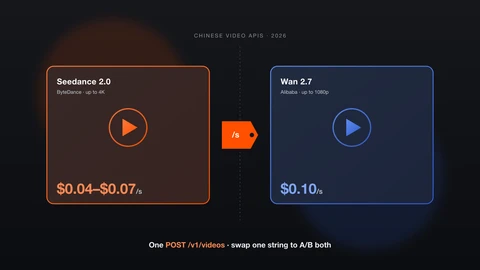
Wan 3.0 and Seedance 2.5 need to be compared at the same resolution and input mode. At 1080p t2v, Wan is $0.21/s; Seedance is $0.60/s at public list price or $0.48/s in the current primary volcengine supplier quote. For five output seconds that is $1.05 versus $3.00 or $2.40. There is no universal 2.2× price ratio.
Current Ofox rates by resolution
All amounts are USD per second. Wan rows show public list prices; the primary supplier quotes match them in this snapshot: alicloud for Wan 3.0, aliyun for Prime and Wan 2.7/2.6. These are dated quotes, not a promise that prices will remain unchanged.
Price check: 2026-09-16. Five-second amounts estimate t2v with no input video; v2v totals require the input-video duration.
| Model / quote | Resolution | USD per second | USD for 5 seconds |
|---|---|---|---|
alibaba/wan-3.0 | 480p | $0.054 | $0.270 |
alibaba/wan-3.0 | 720p | $0.11 | $0.55 |
alibaba/wan-3.0 | 1080p | $0.21 | $1.05 |
bytedance/seedance-2.5 t2v / Public list price | 480p | $0.11 | $0.55 |
bytedance/seedance-2.5 t2v / Public list price | 720p | $0.24 | $1.20 |
bytedance/seedance-2.5 t2v / Public list price | 1080p | $0.60 | $3.00 |
bytedance/seedance-2.5 t2v / Primary supplier quote (volcengine) | 480p | $0.11 | $0.55 |
bytedance/seedance-2.5 t2v / Primary supplier quote (volcengine) | 720p | $0.24 | $1.20 |
bytedance/seedance-2.5 t2v / Primary supplier quote (volcengine) | 1080p | $0.48 | $2.40 |
bytedance/seedance-2.5 v2v / Public list price | 480p | $0.14 | — |
bytedance/seedance-2.5 v2v / Public list price | 720p | $0.30 | — |
bytedance/seedance-2.5 v2v / Public list price | 1080p | $0.71 | — |
bytedance/seedance-2.5 v2v / Primary supplier quote (volcengine) | 480p | $0.14 | — |
bytedance/seedance-2.5 v2v / Primary supplier quote (volcengine) | 720p | $0.30 | — |
bytedance/seedance-2.5 v2v / Primary supplier quote (volcengine) | 1080p | $0.568 | — |
The Seedance rows separate t2v and v2v explicitly. The current volcengine quote reduces the 1080p tiers by 20%; it does not reduce the 480p or 720p tiers. A supplier quote is not a discount guaranteed across all providers. No separate audio price dimension appears in these particular tiers; that must not be generalized to other models or future quotes.
Estimating a five-second clip
Examples assume text-to-video (t2v), 5 seconds of output and no input video. They are estimates from public rates, not measured invoices. For requests with video inputs, include applicable input-video seconds and use the matching input-mode rate. Do not reuse the text-only total for a reference-video job; check final charges against the completed task.
Choosing a model after the price correction
Compare acceptable results at a pinned resolution before choosing on price. Wan supports shorter clips and Seedance lists larger reference limits and 21:9 output. Pin resolution explicitly: Wan defaults to 1080p and Seedance to 720p, so defaults change both the output and the relevant rate. Trimming an output does not undo the generation cost. For reference-video jobs, use the appropriate v2v tier and include applicable input-video seconds in the estimate.
Wan 3.0 vs Seedance 2.5: The Spec Table
| Spec | Wan 3.0 | Seedance 2.5 |
|---|---|---|
| Ofox model ID | alibaba/wan-3.0 | bytedance/seedance-2.5 |
| Duration range | 2-30s | 4-30s |
| Resolutions | 480p / 720p / 1080p | 480p / 720p / 1080p |
| Default resolution | 1080p | 720p |
| Aspect ratios | 16:9, 4:3, 1:1, 3:4, 9:16, adaptive | 21:9, 16:9, 4:3, 1:1, 3:4, 9:16, adaptive |
| Modes | t2v, i2v, v2v | t2v, i2v, v2v |
| Audio by default | yes | yes |
| Max reference images | 10 | 30 |
| Max reference videos | 5, ≤15s total | 10 |
| Max reference audio | 5, ≤15s total | 10 |
Where Seedance 2.5 Earns the Premium
A reference library of 50 assets against Wan’s 20, and 21:9. Those are the two capabilities Wan 3.0 does not match.
Seedance 2.5 accepts up to 30 reference images, 10 reference videos and 10 reference audio clips in a single request. Wan 3.0 accepts 10, 5 and 5, and additionally caps reference video and reference audio at 15 seconds each in total. If your product feeds a character sheet, a location set and a motion reference into every generation, that ceiling is a hard constraint rather than a preference, and it is reached quickly.
The aspect ratio list is the smaller difference but a real one: Seedance lists 21:9, Wan does not. For cinematic letterbox output that is decisive, and cropping a 16:9 render to 21:9 costs you vertical resolution rather than being free.
The Calls Are Nearly Identical
Both models sit on the same Ofox endpoint and take the same parameter names, which makes an A/B cheap to run:
import os, requests

OFOX = "https://api.ofox.ai/v1/videos"
HEAD = {"Authorization": f"Bearer {os.environ['OFOX_API_KEY']}"}

prompt = "A paper boat drifting down a rain gutter, close on the water line"

for model in ["alibaba/wan-3.0", "bytedance/seedance-2.5"]:
    r = requests.post(OFOX, headers=HEAD, json={
        "model": model,
        "prompt": prompt,
        "duration": 5,
        "resolution": "1080p",     # pin it; the two models default differently
        "aspect_ratio": "16:9",
    })
    print(model, r.status_code, r.json().get("id"))
Both expose prompt, duration, resolution, aspect_ratio, size, generate_audio, seed, frame_images, input_references, callback_url and provider. Passing frame_images selects first-frame or first-and-last-frame mode on either; input_references selects reference-to-video. Both are asynchronous: you get a task back and poll it, or supply callback_url and be told instead. The polling and wait-time guide covers what to expect while the task runs.
Pin resolution explicitly in any comparison. Leaving it unset compares 1080p Wan against 720p Seedance and tells you nothing.
Pick Seedance 2.5 When
- You feed more than 10 reference images, or more than 5 reference videos or audio clips, per generation.
- You need 21:9 output.
- Your prompts are already tuned against ByteDance motion behaviour and re-tuning would cost more than the price gap saves. The Seedance 2.5 prompt guide is the reference for that tuning.
Source and billing boundaries
Prices were checked on 16 September 2026 against the public Ofox catalog and the linked model pages. Compare the same resolution, input mode and audio settings, and distinguish public list prices from provider-specific quotes. Estimates assume the stated output length and no input video unless explicitly indicated; video inputs can add billable seconds. These examples are not measured invoices, and final charges depend on the completed task and applicable provider rate. Recheck prices before budgeting production usage.
Frequently Asked Questions
- Is Wan 3.0 cheaper than Seedance 2.5?
- Wan 3.0 and Seedance 2.5 need to be compared at the same resolution and input mode. At 1080p t2v, Wan is $0.21/s; Seedance is $0.60/s at public list price or $0.48/s in the current primary volcengine supplier quote. For five output seconds that is $1.05 versus $3.00 or $2.40. There is no universal 2.2× price ratio.
- What is the shortest clip each model can make?
- Wan 3.0 goes down to 2 seconds, Seedance 2.5 starts at 4. Both cap at 30 seconds. If your product cuts 2 or 3 second clips, Seedance cannot produce them and you would be paying for and trimming a 4-second minimum.
- Which model takes more reference material?
- Seedance 2.5, by a wide margin. It accepts up to 30 images, 10 videos and 10 audio clips, 50 reference assets in total. Wan 3.0 accepts up to 10 images, 5 videos and 5 audio clips, and caps the reference video and audio at 15 seconds each in total.
- Do both models output audio?
- Yes, both list supports_audio as true and both return synced audio by default, so neither needs a separate voice pass. Both expose a generate_audio parameter on Ofox if you want to turn it off.
- What resolutions do Wan 3.0 and Seedance 2.5 support?
- Both list 480p, 720p and 1080p on Ofox. The defaults differ: Wan 3.0 defaults to 1080p and Seedance 2.5 defaults to 720p, so an identical request with no resolution set produces a different output size on each.
- Which one should I pick for a video generation product?
- Pick Wan 3.0 when cost per clip drives the decision, when you need clips under 4 seconds, or when 1080p is the default output. Pick Seedance 2.5 when you are feeding it a large reference library, when you need the 21:9 aspect ratio that Wan does not list, or when you have already tuned prompts against ByteDance motion behaviour.