DeepSeek V4 Pro 0813: Price, Open Weights, Benchmarks (2026)
V4 Pro 0813 scores 53 on Artificial Analysis at $0.06 per task, 5x under GLM-5.2. MIT weights are now public. Peak/off-peak pricing starts 2026-08-16.
 Ofox
Ofox 
September 10 update: DeepSeek schedules the direct V4 Pro API transition to V4.1 Flash for September 14 at 12:00 Beijing time (04:00 UTC). Use the migration checklist and current Flash pricing before relying on the August release information below.
Pricing update (2026-08-17): DeepSeek moved the whole V4 family to peak/off-peak billing at 16:00 UTC on 2026-08-16. The DeepSeek rates quoted on this page are from before that change. Current rates, the multiplier on each tier, and the peak-hour windows are in DeepSeek API Price Increase. DeepSeek shipped DeepSeek-V4-Pro-0813 on 2026-08-13, and three days later the price of running it goes up. The GA build costs exactly what the preview did. From 16:00 UTC on 2026-08-16 the whole V4 family moves to peak and off-peak rates, and every tier of that new schedule sits above today’s.
Released:        2026-08-13, GA; docs footnote first, change log entry same day
Model ID:        deepseek-v4-pro (unchanged, no 0813 suffix)
Price now:       $0.435 in / $0.87 out per 1M; $0.003625 cache hit
Price 08-16:     off-peak $0.66 / $1.98; peak $1.32 / $3.96
Open weights:    published 2026-08-13, MIT, 66 fp8 shards, ungated
Context:         1M in, 384K max output
Thinking:        on by default, effort low / high / max
Intelligence:    53 on the AA Intelligence Index, up 8 from the preview build
Cost per task:   $0.06, the cheapest of any model scoring 53
Providers:       3 (DeepSeek, plus Cloudflare and GMICloud at 3-4x)
What Is DeepSeek V4 Pro 0813?
It is the GA build of DeepSeek’s flagship, replacing the April preview behind the same model ID. The specs on the official pricing page are 1.6T total parameters with 49B active, mixture-of-experts, text only.
Nothing about the calling convention changed. You send deepseek-v4-pro and you get the 0813 build. There is no deepseek-v4-pro-0813 model name on DeepSeek’s own API, the same pattern the Flash release used two weeks earlier.
On ofox the model is deepseek/deepseek-v4-pro-0813.
When Was DeepSeek V4 Pro 0813 Released?
2026-08-13, in two stages. The first sign was a footnote on the quick-start and pricing pages saying deepseek-v4-pro has been updated to DeepSeek-V4-Pro-0813. For most of the day that footnote was the entire announcement.
The change log entry followed later the same day, and it is the one to read: it calls this the GA release of V4 Pro across app, web and API, lists ten benchmark scores, announces the pricing change described below, and documents three thinking effort levels. It is also the follow-up to the 2026-07-31 Flash entry, the one containing the sentence “The official release of DeepSeek-V4-Pro will follow soon.”
DeepSeek’s launch post landed the same evening with one detail the docs do not carry: on the consumer app and the web client, the GA build is not the default. It sits behind Expert Mode. If you are comparing app answers against API answers, that toggle is the difference between testing 0813 and testing whatever the app serves by default.
The practical lesson is about polling rather than about DeepSeek. A vendor’s model can be live in the API hours before the page you monitor says anything, so a release check that reads only the change log will be late, and one that reads only the model list will miss the pricing note attached to it.
Worth knowing if you script against those docs: the /news/ paths are a catch-all. Requesting a news URL that does not exist returns HTTP 200 with the quick-start page body, so a status-code check will tell you a nonexistent announcement is live.
Is DeepSeek V4 Pro 0813 Open Source?
Yes, as of 2026-08-13, and the timing is worth knowing because most of the release-day coverage was written before it was true.
deepseek-ai/DeepSeek-V4-Pro-0813holds 66 safetensors shards in fp8, MIT, ungated, alongside aconfig.jsonand DeepSeek’s own encoding utilities.- The repository is stamped 2026-08-13, but it did not appear in the organisation’s public model list when we checked that morning UTC. It was there by the evening, roughly half a day after the API went GA.
- The older
deepseek-ai/DeepSeek-V4-Prorepo, last modified 2026-06-22, is the April preview: 64 shards, also MIT. Do not grab that one by accident; the names differ by a suffix and the builds differ by eight index points. unsloth/DeepSeek-V4-Pro-0813-GGUFhad already staked out the name earlier in the day with nothing in it but a README. Quantisations are what fills in next.
Two things follow. Artificial Analysis had tagged the 0813 entry “Open weights model” while no such repository was reachable — the label was early rather than wrong, the same way it was early on Flash 0731. And any comparison table that lists V4 Pro 0813 as closed-weight, including several written on release day, is now describing a window that lasted less than a day.
How Much Does DeepSeek V4 Pro Cost?
$0.435 per million input on a cache miss and $0.87 output until 2026-08-16, then peak and off-peak rates that are higher in both halves.
| Item | V4 Pro | V4 Flash |
|---|---|---|
| Input, cache hit | $0.003625 | $0.0028 |
| Input, cache miss | $0.435 | $0.14 |
| Output | $0.87 | $0.28 |
| Concurrency limit | 500 | 2,500 |
The cache hit rate is what actually decides your bill here, since a hit costs 120x less than a miss. We worked through that math on the preview build in DeepSeek V4 Pro real cost, and the ratios are unchanged.
What Changes on 2026-08-16?
The vague warning DeepSeek posted on 2026-08-06 — “a significant increase expected”, no amount, no date — became a schedule with the GA release. From 16:00 UTC on 2026-08-16, billing splits into peak and off-peak, with off-peak set at half of peak. Peak hours are 01:00–04:00 and 06:00–10:00 UTC; everything else is off-peak.
| Per 1M tokens | Today | Off-peak from 08-16 | Peak from 08-16 |
|---|---|---|---|
| V4 Pro, cache hit | $0.003625 | $0.022 | $0.044 |
| V4 Pro, cache miss | $0.435 | $0.66 | $1.32 |
| V4 Pro, output | $0.87 | $1.98 | $3.96 |
| V4 Flash, cache hit | $0.0028 | $0.007 | $0.014 |
| V4 Flash, cache miss | $0.14 | $0.22 | $0.44 |
| V4 Flash, output | $0.28 | $0.66 | $1.32 |
Three things to take from that table. Off-peak is not a discount against today’s rate, it is a smaller increase: V4 Pro output goes up 2.3x off-peak and 4.6x at peak. The cache-hit line moves most in relative terms, 6x off-peak, which quietly weakens the main lever people use to keep DeepSeek cheap. And the two peak windows are short and awkwardly placed — 01:00–04:00 and 06:00–10:00 UTC covers most of the Chinese working day, so whether this reads as a rise or a small rise depends mostly on where your batch jobs run.
The eight-point jump and the price rise arrived in the same change log entry, which is the honest way to read this release: DeepSeek is charging for the improvement rather than absorbing it. For the levers that still work after the 16th, see six ways to pay less before the increase.
What Is the Context Window and Max Output?
1M tokens in, 384K maximum output, the same on both V4 models.
That output ceiling is unusually high. Most flagships cap output between 64K and 128K, so a single V4 Pro call can legitimately produce a book-length response. It also means max_tokens is not a safety net by default, and a runaway generation on Pro can bill 384,000 output tokens at $0.87 per million before it stops.
For how the window is actually consumed by system prompts, tool schemas and reasoning tokens, see what is a context window.
How Does V4 Pro 0813 Score on Benchmarks?
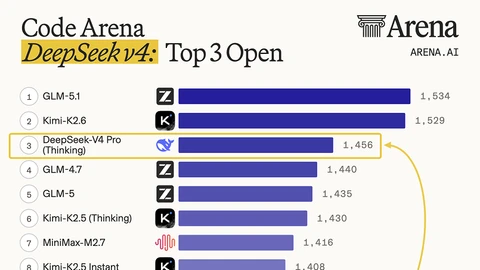
Two sets of numbers exist, and they are not interchangeable: DeepSeek’s own agentic scores, and Artificial Analysis’s independent index, where V4 Pro 0813 reads 53, up from 45 on the preview build.
DeepSeek’s change log entry publishes these for the GA build. They are vendor-run and there is no methodology note attached — worth stating plainly, because the Flash 0731 entry six weeks earlier did specify its harness (DeepSeek Harness minimal mode, max effort, top_p 0.95, temperature 1.0) and this one specifies nothing.
| Benchmark | V4 Pro 0813 | V4 Flash 0731 |
|---|---|---|
| Terminal Bench 2.1 | 87.9 | 82.7 |
| Cybergym | 83.3 | 76.7 |
| Toolathlon-Verified | 74.1 | 70.3 |
| DSBench-FullStack | 71.1 | 68.7 |
| DSBench-Hard | 67.2 | 59.6 |
| DeepSWE | 62.7 | 54.4 |
| NL2Repo | 61.5 | 54.2 |
| HLE, without / with tools | 42.7 / 60.0 | not published |
| AutomationBench (Public) | 31.8 | 25.1 |
| Agents’ Last Exam | 25.7 | 25.2 |
Both columns come from DeepSeek’s own change log, so the comparison between them is internally consistent even though neither is independently reproduced. Two of the ten are internal test sets DeepSeek does not release — DSBench-FullStack and DSBench-Hard — so those rows cannot be checked by anyone outside the company at all.
Artificial Analysis is the independent read. Where V4 Pro 0813 sits on the full leaderboard, Index v4.1.1, snapshot 2026-08-13:
| Rank | Model | Index | Cost per task |
|---|---|---|---|
| 1 | Claude Opus 5 (max) | 63 | $2.34 |
| 7 | Kimi K3 (max) | 60 | $0.84 |
| 17 | DeepSeek V4 Pro 0813 (max) | 53 | $0.06 |
| 18 | GPT-5.6 Terra (xhigh) | 53 | $0.31 |
| 19 | GLM-5.2 (max) | 53 | $0.32 |
| 22 | DeepSeek V4 Flash 0731 (max) | 52 | $0.03 |
| 36 | DeepSeek V4 Pro (April preview, max) | 45 | $0.05 |
The row that matters is the cost column, not the rank. Three models tie at 53, and V4 Pro 0813 runs about 5x cheaper per task than either of the other two.
Two cautions on how this number gets quoted:
- AA’s model page says “#2 / 104” and that is not an overall rank. It is the position within open weights models of the same size class. On the full board, 53 puts it around 17th.
- The index is a rolling benchmark. Flash 0731 read 50 when it launched and reads 52 now, because AA moved from v4.1 to v4.1.1 and recomputed. Cite the ordering rather than the absolute number, and date whatever you cite.
Three supporting figures from the same snapshot, all measured on the max-effort configuration:
- Verbosity 128M output tokens across the index run, against 206M for Flash 0731. Pro reaches a higher score using fewer words, which is the opposite of the usual pattern.
- 83.2 output tokens per second, first chunk at 1.63s. For comparison, Claude Opus 5 at max effort takes 63.9s to first chunk and GPT-5.6 Sol at max takes 176.6s.
- $135.03 total to run the full index, versus $72.03 for Flash 0731.
Where Can You Run V4 Pro 0813 Besides DeepSeek?
Two other places so far, both at three to four times the price, and the list is growing by the day. The OpenRouter endpoints API listed two providers for deepseek/deepseek-v4-pro-0813 on 2026-08-13 and three on 2026-08-14:
| Provider | Input / output per 1M |
|---|---|
| DeepSeek | $0.435 / $0.87 |
| Cloudflare | $1.32 / $3.96 |
| GMICloud (fp8) | $1.74 / $3.48 |
Flash 0731 has 28 listed endpoints, and that is the shape Pro is heading towards now that its weights are public — the third provider appeared within a day of the repository going up. Two practical consequences, both true today and both with a shelf life:
- No cheaper third-party route exists yet. With Flash, shopping hosts is a real lever, and cache-read rates alone vary about 27x between them. Every alternative Pro host currently costs 3-4x the source rate, and GMICloud’s cache reads run $0.145 against DeepSeek’s $0.003625.
- Failover exists, but budget for it. If DeepSeek’s endpoint is saturated you can retry elsewhere at three to four times the bill and without the implicit prompt caching DeepSeek’s own endpoint advertises. That is a fallback for an outage, not for steady traffic — at least until enough hosts show up to compete on price.
Watch the slug when you wire this up. deepseek/deepseek-v4-pro-0813 is the new build. Plain deepseek/deepseek-v4-pro on OpenRouter is still the April preview and carries a summary price of $1.168 in / $2.336 out, roughly 2.7x the current official rate for a weaker model. The Flash release had the identical trap.
How Do I Access DeepSeek V4 Pro 0813?
Point an OpenAI-compatible client at DeepSeek and send deepseek-v4-pro. Both the OpenAI and Anthropic protocols work, and as of this release the Responses API works on Pro too.
from openai import OpenAI

client = OpenAI(
    base_url="https://api.deepseek.com",
    api_key="YOUR_DEEPSEEK_API_KEY",
)

response = client.chat.completions.create(
    model="deepseek-v4-pro",
    messages=[{"role": "user", "content": "Hello!"}],
    reasoning_effort="high",
)
print(response.choices[0].message.content)
The Responses API support is new for Pro. On 2026-07-31 DeepSeek’s position was that native Responses support shipped with Flash and Pro would follow in early August. The pricing page now marks it supported on both, and the GA change log entry says the format is “specifically adapted for Codex” with a one-click configuration script. That matters mainly for Codex CLI, since that client only speaks wire_api = "responses".
Why Does Thinking Behave Differently Depending on Where You Call It?
Reasoning defaults are not part of a model. They are a property of whatever endpoint you happen to be calling, and nothing in a response tells you which default you got.
DeepSeek’s own thinking mode documentation is explicit that thinking is on by default for V4 with effort set to high, and as of this release it documents three effort levels rather than one switch: low, high and max. It also publishes the mapping for the OpenAI-style values that have no equivalent — medium and xhigh both resolve to high — so two of the five strings you might send are silently collapsed even on DeepSeek’s own endpoint.
Route the same model ID through a gateway and the default itself can change, without any error and without any field in the response marking it. We measured this on 2026-08-13 against the then-unsuffixed deepseek/deepseek-v4-pro on an OpenAI-compatible gateway with one bat-and-ball prompt, three runs per configuration:
| Request | Completion tokens (3 runs) | reasoning_content | Answer |
|---|---|---|---|
| No reasoning params | 4, 4, 4 | empty | correct |
reasoning_effort: "high" | 201, 248, 294 | empty | correct |
reasoning_effort: "max" | 178, 179, 460 | empty | correct |
thinking: {"type": "enabled"} | 4, 90, 95 | empty | correct |
Three things fall out of that table. Thinking was off by default on this route, against the vendor default of on, and consistently so. Turning it on cost fifty to seventy-five times the output tokens for the same one-word answer, which is the entire billing story on a reasoning model — and note the spread within each row, which is why a single measurement of reasoning cost is worth very little. And DeepSeek’s native thinking parameter did nothing: its three runs land in the same range as sending no parameters at all, while OpenAI’s reasoning_effort moves the number every time. The parameter name you need depends on the gateway, not on the model.
Reasoning tokens were billed as completion tokens in every case without the reasoning text being returned. That is normal, and it is also why a bill can triple while the visible output stays the same length.
The check that costs nothing: send one arithmetic prompt with no reasoning parameters and read usage.completion_tokens, three times rather than once. Single digits every time means thinking is off. Hundreds means it is on and you are paying for it. Do this against any new endpoint before you size a budget on it, and repeat it when a provider silently updates a model behind a stable ID, which is exactly what happened here.
If you want to compare two models’ reasoning economics without opening two vendor accounts, an OpenAI-compatible gateway lets you swap the model string and keep everything else fixed. On ofox the two IDs are deepseek/deepseek-v4-pro-0813 and deepseek/deepseek-v4-flash-0731, against the same base_url and the same key.
for model_id in ["deepseek/deepseek-v4-pro-0813", "deepseek/deepseek-v4-flash-0731"]:
    r = client.chat.completions.create(
        model=model_id,
        messages=[{"role": "user", "content": PROMPT}],
        reasoning_effort="high",
    )
    print(model_id, r.usage.completion_tokens)
One caveat on that route, in the interest of not overclaiming: when we ran the table above, ofox carried a single unsuffixed deepseek/deepseek-v4-pro stamped 2026-04-24, so which build answered was not verifiable from the outside. That entry has since split into deepseek/deepseek-v4-pro-0423 and deepseek/deepseek-v4-pro-0813, the model page for the latter now reads 2026-08-13, and the unsuffixed slug returns a 404 (checked 2026-08-28) — the build is pinned by the model string. The parameter behaviour above is independent of that question.
DeepSeek V4 Pro 0813 vs V4 Flash 0731
One index point apart, double the price per task.
| V4 Pro 0813 | V4 Flash 0731 | |
|---|---|---|
| AA Intelligence Index | 53 | 52 |
| Cost per index task | $0.06 | $0.03 |
| Output tokens, index run | 128M | 206M |
| Output speed | 83.2 tok/s | 115 tok/s |
| Total parameters | 1.6T / 49B active | 284B / 13B active |
| Weights published | yes, MIT, 2026-08-13 | yes, MIT |
| Hosting providers | 3 | 28 |
| Concurrency | 500 | 2,500 |
Pro closed most of the quality gap this release and none of the price gap. Flash remains the default for agent loops and high-volume work, on cost, concurrency and failover options all at once. Pro earns its premium on the hardest single calls, where one point of index score is worth twice the money.
The full task-type breakdown is in V4 Pro vs Flash, which was written against the preview build and the routing guidance still holds, now by a narrower margin.
For the per-vendor price map and the six mechanisms behind it, see the pricing index.
References
- DeepSeek API pricing
- DeepSeek first API call
- DeepSeek change log
- DeepSeek launch announcement, 2026-08-13
- DeepSeek thinking mode documentation
- Hugging Face: deepseek-ai/DeepSeek-V4-Pro-0813
- Hugging Face: deepseek-ai/DeepSeek-V4-Pro
- Hugging Face: unsloth/DeepSeek-V4-Pro-0813-GGUF
- Artificial Analysis: DeepSeek V4 Pro 0813
- Artificial Analysis model leaderboard
- OpenRouter: deepseek/deepseek-v4-pro-0813
Frequently Asked Questions
- When was DeepSeek V4 Pro 0813 released?
- 2026-08-13, as the GA release of DeepSeek V4 Pro across the app, web and API. The first sign of it was a footnote on the API docs quick-start and pricing pages saying deepseek-v4-pro now points to DeepSeek-V4-Pro-0813; the full change log entry, with benchmark numbers and a pricing announcement, went up later the same day.
- Did DeepSeek raise prices with the 0813 release?
- Not on release day, but a rise is now dated. Through 2026-08-16 V4 Pro stays at $0.435 per million input tokens on a cache miss, $0.003625 on a cache hit and $0.87 output. From 16:00 UTC on 2026-08-16 the whole V4 family moves to peak and off-peak rates: V4 Pro becomes $0.66 in / $1.98 out off-peak and $1.32 in / $3.96 out at peak, so even the cheaper half of the new schedule is about 1.5x today's input and 2.3x today's output.
- Can I download DeepSeek V4 Pro 0813 weights?
- Yes, since 2026-08-13. deepseek-ai/DeepSeek-V4-Pro-0813 on Hugging Face carries 66 safetensors shards in fp8 under MIT, ungated, published about half a day after the API went GA. It was not reachable when we checked earlier that day, so anything you read about V4 Pro 0813 being closed-weight was written in the window before the repository went public.
- Is V4 Pro 0813 worth it over V4 Flash 0731?
- Only for the hardest tier of work. On the Artificial Analysis Intelligence Index the gap is 53 versus 52, one point, while the weighted cost per task is $0.06 versus $0.03. You pay double for one point. Flash also has 28 hosting providers to Pro's three, so failover options are still far better on Flash, though both models now have public weights and Pro's list should grow.
- Does DeepSeek V4 Pro support the Responses API now?
- Yes. The pricing page marks Responses API as supported for both deepseek-v4-flash and deepseek-v4-pro as of 2026-08-13. When Flash 0731 shipped on 2026-07-31, DeepSeek's position was that Responses support was Flash-only with Pro planned for early August. That plan landed.
- Which OpenRouter slug points at the new build?
- deepseek/deepseek-v4-pro-0813. The unsuffixed deepseek/deepseek-v4-pro is still the April preview and carries a much higher summary price of $1.168 input and $2.336 output. This repeats the trap from the Flash release, where the plain slug kept pointing at the older 0423 build.
- How many providers host DeepSeek V4 Pro 0813?
- Three, checked on the OpenRouter endpoints API on 2026-08-14: DeepSeek itself at $0.435 / $0.87, Cloudflare at $1.32 / $3.96 and GMICloud at $1.74 / $3.48, three to four times the source rate. That count was two the day before, and Flash 0731 already has 28, so expect Pro's list to keep growing now that its weights are public. Failover targets exist; cheaper ones do not.
- What are DeepSeek's own benchmark numbers for V4 Pro 0813?
- From the 2026-08-13 change log entry: Terminal Bench 2.1 87.9, Toolathlon-Verified 74.1, DSBench-FullStack 71.1, DSBench-Hard 67.2, DeepSWE 62.7, NL2Repo 61.5, Cybergym 83.3, AutomationBench (Public) 31.8, Agents' Last Exam 25.7, and HLE 42.7 without tools / 60.0 with tools. DeepSeek publishes no methodology note for these, unlike the Flash 0731 entry, which specified the harness and effort level.
- Which thinking effort levels does V4 Pro accept?
- Three: low, high and max, documented as of 2026-08-13 for both V4 Pro and V4 Flash. Thinking is on by default at high. The docs also publish the mapping for the OpenAI-style values that do not map one to one: medium and xhigh both resolve to high.
- Does the 0813 build change anything about my existing code?
- No. The model ID, base URL, both protocols and the parameter set are unchanged, so you are already on it. The one thing to schedule is the 2026-08-16 pricing change, which affects your bill rather than your code.
- Is V4 Pro 0813 better than GLM-5.2?
- They tie at 53 on the Artificial Analysis index. V4 Pro costs about a fifth as much per task, $0.06 against $0.32. Both ship open weights now; GLM-5.2 has the longer list of third-party hosts, since V4 Pro 0813's weights only went public on 2026-08-13.
- Why is my V4 Pro bill higher than the sticker suggests?
- Most likely cache misses, which cost 120x a cache hit, or thinking being on. Send a trivial arithmetic prompt three times with no reasoning parameters and read usage.completion_tokens: single digits every time means thinking is off, hundreds means it is on and billed.
- Does V4 Pro support FIM completion?
- Yes, in non-thinking mode only, and it is still marked Beta on the pricing page. Same restriction as V4 Flash.