Gemini 4 Hydrogen vs Claude Haiku 5.5 and GPT-6 Luna: Is Hydrogen a Budget Model?
Hydrogen lists at 15x the per-token price of Haiku 5.5 and Luna. We compare official prices, Artificial Analysis cost per task and a 24-call triage test to show when the extra cost buys something.
 Ofox

No. Gemini 4 Hydrogen is Google’s mid-priced general model, not its budget tier. At Google’s paid Standard rates it costs $1.50 per million input tokens and $7.50 per million output tokens, 15 times the short-prompt rates of Claude Haiku 5.5 and GPT-6 Luna ($0.10 and $0.50 each). The gap per completed task can be larger still, because Hydrogen thinks at high by default and spends more output tokens on the same job. Google’s own guide points high-volume classification and routing at Gemini 3.5 Flash-Lite, not Hydrogen.
That does not make Hydrogen a bad buy. On Artificial Analysis’s Intelligence Index it scores roughly twice what Haiku 5.5 and Luna score at their default settings. On a simple, well-specified triage job, we found that extra capability made no difference: Haiku and Luna were just as accurate in our test and cost far less.
Ofox publishes this article, and all four models in it could be called through Ofox when we checked on November 19, 2026. Everything below is labelled as one of three things: official documentation (checked November 19, 2026), Artificial Analysis data (fetched November 19, 2026), or our own small test run through Ofox on the same date. Dollar amounts in the test are our arithmetic using each vendor’s official list prices, not Ofox billing. Ofox’s own prices are shown on each model page linked at the end.
Official list prices on the same basis
All rates are USD per one million tokens, paid Standard tier, first-party API. Output prices include thinking or reasoning tokens for all four models.
| Model (API ID) | Input | Output | Cached input | Price condition | Batch input / output |
|---|---|---|---|---|---|
Gemini 4 Hydrogen (gemini-4-hydrogen) | $1.50 | $7.50 | $0.075 (implicit only) | One rate at any prompt length | $0.75 / $3.75 |
Claude Haiku 5.5 (claude-haiku-5-5) | $0.10 | $0.50 | $0.01 read; $0.125 5-min write | Prompt ≤100,000 tokens | $0.05 / $0.25 |
| Claude Haiku 5.5, prompt >100K | $0.50 | $2.50 | $0.05 read; $0.625 5-min write | Applies to the whole request | $0.25 / $1.25 |
GPT-6 Luna (gpt-6-luna) | $0.10 | $0.50 | $0.01 | Input ≤272K tokens | $0.05 / $0.25 |
| GPT-6 Luna, input >272K | $0.20 | $0.75 | $0.02 | Applies to the whole request | $0.10 / $0.375 |
Gemini 3.5 Flash-Lite (gemini-3.5-flash-lite) | $0.30 | $2.50 | $0.03 + $1.00/1M tokens/hour storage | One rate | $0.15 / $1.25 |
Sources: Google Gemini API pricing, Anthropic pricing, OpenAI pricing and the GPT-6 Luna model page.
Three details change the comparison more than the headline ratio does.
Haiku 5.5’s low price has a ceiling. Anthropic prices Haiku 5.5 by prompt length. A request whose prompt is over 100,000 tokens pays five times the base rates, and that applies to the whole request, output included. Cache reads and cache writes count toward the 100K. Above that line, Hydrogen is only three times Haiku’s price rather than fifteen. Our Haiku 5.5 100K pricing guide works through the boundary with exact numbers. Luna has a similar step at 272K input tokens. Hydrogen’s table lists no long-context tier.
Hydrogen has a free tier. Anthropic’s and OpenAI’s pricing pages list only paid rates for Haiku 5.5 and Luna. Google lists both Hydrogen and 3.5 Flash-Lite as free of charge on its free tier, which helps with prototypes. Google’s table also marks free-tier content as used to improve its products, and access depends on project eligibility and limits. Our Hydrogen setup guide covers verification and quota.
Flash-Lite is cheaper than Hydrogen but not cheaper than Haiku or Luna. Its input rate is three times theirs and its output rate five times. Within Google’s lineup it is the low-cost option. Compared with the other vendors it isn’t the cheapest.
What a task actually costs: Artificial Analysis data
Per-token price leaves out how many tokens each model uses. Artificial Analysis (AA) runs its Intelligence Index evaluations on each model and reports a weighted average cost per task, built from the tokens each model actually used and that model’s prices. We fetched the four model pages on November 19, 2026. The first table uses each vendor’s documented default setting: high thinking for Hydrogen (Google’s Hydrogen guide), medium effort for Haiku 5.5 (Anthropic models overview) and medium for Luna (OpenAI model page).
AA’s rendered pages show a per-task cost only for each model’s top setting. The per-task costs for the other settings come from the data behind the same pages, where each cost is tagged with its variant (for example claude-haiku-5-5-medium or gemini-4-hydrogen-high), so the effort labels below are AA’s own, not our matching. The index scores for each label agree with the rendered pages.
| Model at default setting | AA Intelligence Index | AA cost per Index task | AA output speed |
|---|---|---|---|
| Gemini 4 Hydrogen (high) | 51 | $1.87 | 165 tokens/s |
| Claude Haiku 5.5 (medium) | 25 | $0.092 | 222 tokens/s |
| GPT-6 Luna (medium) | 18 | $0.042 | 96 tokens/s |
| Gemini 3.5 Flash-Lite (single variant listed) | 12 | $0.69 | 318 tokens/s |
At default settings, Hydrogen costs about 20 times Haiku per AA task and about 44 times Luna. Both gaps are larger than the 15x token-price ratio, because Hydrogen at high produces more tokens per task. The capability gap runs the same way: Hydrogen’s index score is roughly double Haiku’s and close to triple Luna’s.
The picture changes when you raise effort on the cheaper models:
| Highest listed setting | AA Intelligence Index | AA cost per Index task |
|---|---|---|
| Gemini 4 Hydrogen (xhigh) | 54 | $3.16 |
| Claude Haiku 5.5 (max) | 36 | $0.41 |
| GPT-6 Luna (max) | 28 | $0.15 |
At the top settings the Haiku gap shrinks to about 7.7x, because Haiku at max uses many more tokens. Luna stays about 21x cheaper. Even at max, though, neither reaches Hydrogen’s medium score (41 on AA’s page). In AA’s page data, Hydrogen at medium costs $0.80 per task: about twice Haiku at max ($0.41) for a score 5 points higher. If your workload looks like AA’s hard reasoning and agentic tasks, Hydrogen at a lower setting can be a better buy than a small model pushed to its limit.
Read these numbers with their limits in mind:
- AA’s index is a set of hard evaluations. A score of 25 does not mean Haiku fails three quarters of your extraction jobs. Our test below shows Haiku and Luna were fully accurate on a simple, rule-driven job.
- AA’s speed figures are its own measurements. Hydrogen’s time to first answer token at
highwas listed as 19.4 seconds, versus 9.1 for Haiku atmediumand 5.3 for Luna atmedium. That includes thinking time. - AA’s Flash-Lite cost per task ($0.69) is not a fair “per request” figure. In AA’s own breakdown most of that number is cache-related input cost, not output. For a short, one-off request, Flash-Lite cost us less than Hydrogen, as the test shows.
Our test: 20 triage items plus 3 short reasoning items
We wanted to see what these numbers mean for the work people actually buy budget models for: many short items, a fixed rule sheet, a JSON answer. On November 19, 2026, we ran the same prompts through Ofox’s OpenAI-compatible endpoint (https://api.ofox.ai/v1/chat/completions) with these exact model IDs: google/gemini-4-hydrogen, anthropic/claude-haiku-5.5, openai/gpt-6-luna and google/gemini-3.5-flash-lite.
Settings. Default model settings: no temperature, no thinking or reasoning parameter. The only parameter we set was max_tokens: 32000, as a spending cap, and no response hit it (every finish_reason was stop).
Workload A, triage. One request containing 20 customer-support messages. For each message the model returns category (five classes), order_id (the first valid ORD- plus six digits, uppercased, or null) and refund (true only for an explicit request for money back). We wrote the answer key before calling any model. Several items are deliberately tricky: a five-digit order ID that must be rejected, a phone number and a ticket number as distractors, an explicit “not asking for a refund”, a Spanish message, sarcasm, an error page that appears on the billing screen but is a bug, and messages with two issues where the first one decides. Each model ran this request twice.
Workload B, reasoning. Three separate prompts with a single checkable answer: a retry-cost calculation (answer: $3.8064), two business-hours SLA deadlines (Monday 13:00; Tuesday 17:00) and three refund-policy decisions that need day counting (yes, no, yes). One run each.
The full prompts, rule sheet, answer key, runner and scorer are linked in the reproduction section below.
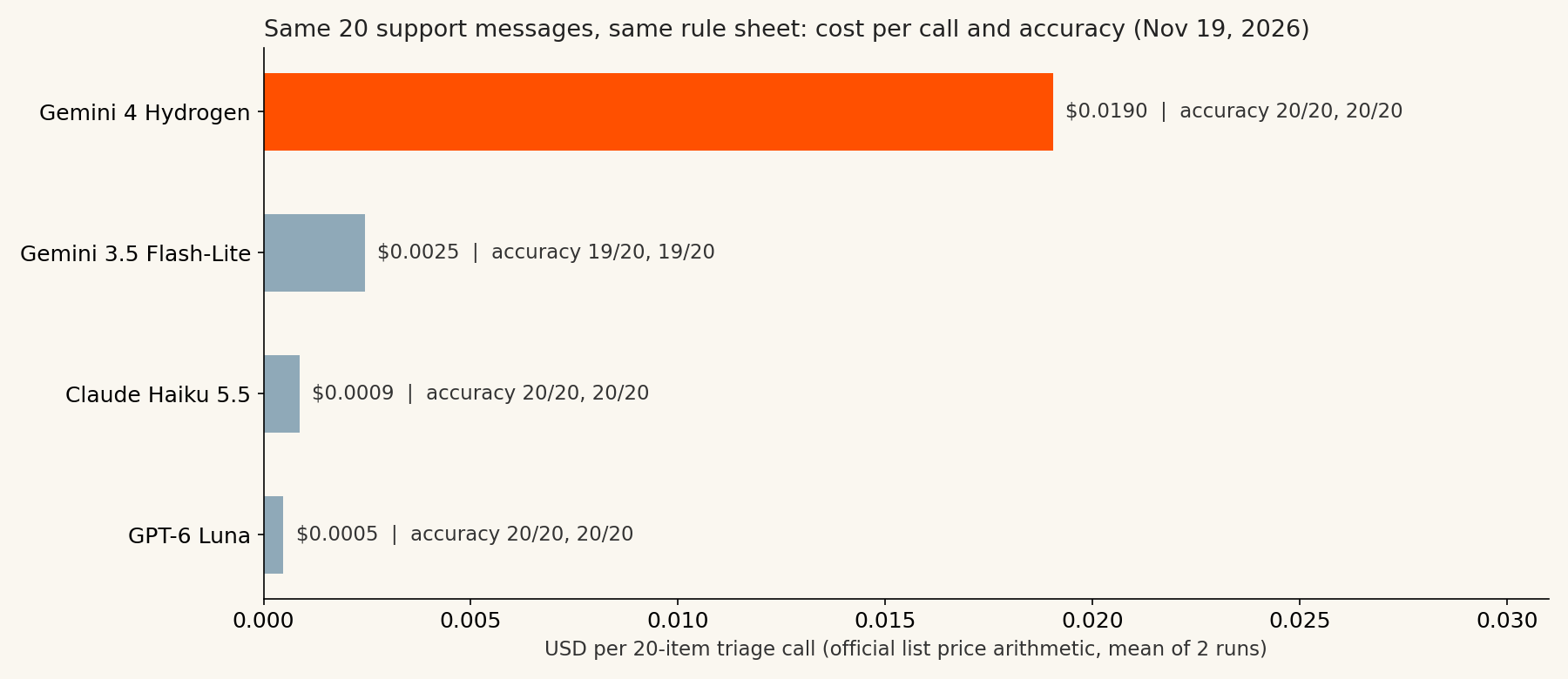
Chart from our November 19, 2026 runs: mean of two triage calls per model, priced at official first-party list rates. Not Ofox billing.
Accuracy and cost results
| Model | Triage accuracy (2 runs) | Reasoning items | Avg triage latency | Avg output tokens per triage call (thinking) | Triage cost per call | Same rate per 1,000 messages |
|---|---|---|---|---|---|---|
| Gemini 4 Hydrogen | 20/20, 20/20 | 3/3 | 16.1 s | 2,336 (≈1,698) | $0.0190 | ≈$0.95 |
| Claude Haiku 5.5 | 20/20, 20/20 | 3/3 | 7.8 s | 1,476 (≈831) | $0.00086 | ≈$0.043 |
| GPT-6 Luna | 20/20, 20/20 | 3/3 | 8.3 s | 780 (≈239) | $0.00048 | ≈$0.024 |
| Gemini 3.5 Flash-Lite | 19/20, 19/20 (59/60 fields each) | 2/3 | 3.6 s | 861 (none reported) | $0.00245 | ≈$0.12 |
Cost is official list price arithmetic: the input and output tokens reported in each response, multiplied by the first-party Standard rates in the first table. Haiku and Luna were billed at their lower tiers here since every prompt was far below 100K tokens. Latency is wall-clock time from our client through Ofox to a complete non-streamed response, including network time. It is not time to first token. The “per 1,000 messages” column simply scales the measured batch cost by 50. It assumes the same prompt shape and no retries.
Across all five calls per model, the totals were $0.0578 for Hydrogen, $0.0024 for Haiku, $0.0012 for Luna and $0.0071 for Flash-Lite. On this workload Hydrogen cost about 24 times Haiku and 46 times Luna. Its 15x token-price premium grew because it generated more output tokens, mostly thinking, for the same answers.
What the runs showed:
- Hydrogen’s extra capability did not change the result. All three of Hydrogen, Haiku and Luna got every field right in both triage runs and all three reasoning items. On a well-specified job with a clear rule sheet, the cheaper models were enough.
- Luna was the most token-efficient. It reported about 240 reasoning tokens per triage call against roughly 1,700 for Hydrogen and 830 for Haiku. Different tokenizers mean token counts are not perfectly comparable across vendors, but the cost difference comes from these counts.
- Flash-Lite was fastest and missed twice. Both triage runs returned
ORD-77812for item 7, a five-digit ID the rules say to reject. On the refund-policy item it counted October 10 to November 15 as 21 days instead of 36 and approved a refund that the 30-day rule should block. Flash-Lite reported no reasoning tokens. Ofox’s Gemini thinking guide notes that the Flash-Lite series does not think by default. - One Haiku call was slow. The retry-cost prompt took 18.8 seconds; its other two reasoning calls took about 4 seconds. One run does not tell us whether that is typical.
Can you make Hydrogen cheaper by lowering thinking?
Google says low gives the lowest token use and latency, so we re-ran the triage request on Hydrogen twice with reasoning_effort: "low" requested on the OpenAI-compatible route and twice with thinkingConfig.thinkingLevel: "low" requested on Ofox’s Gemini-native route. Both are the documented ways to set the level on Ofox. Both routes accepted the request (HTTP 200), but neither response states which level was applied, so the effect of the setting is not confirmed.
| Hydrogen triage, 2 runs each | Accuracy | Thinking tokens | List-price cost per call | Latency |
|---|---|---|---|---|
| Default (no parameter) | 20/20, 20/20 | 1,585 / 1,811 | $0.0182 / $0.0199 | 16.2 / 16.1 s |
reasoning_effort: "low" requested | 20/20, 20/20 | 1,564 / 1,650 | $0.0180 / $0.0187 | 15.8 / 17.1 s |
Native thinkingLevel: "low" requested | 20/20, 20/20 | 1,478 / 1,630 | $0.0174 / $0.0185 | 19.1 / 18.8 s |
On this prompt, requesting low barely moved thinking tokens, cost or latency. The low setting was requested; its effect is not confirmed. We cannot tell from the response whether the level was applied and the model simply judged the 20-item batch worth that much thinking, or whether the setting was not applied on these routes. Either way, do not assume a lower level will bring Hydrogen’s cost down to Haiku or Luna. Measure it on your own prompts. Our sibling article on Gemini 4 thinking levels goes into the levels in more detail.
Limits of this test
This is an illustration, not a benchmark. It is 24 calls, one batch shape, one rule sheet and three reasoning prompts, all run on a single day. A perfect score on 20 items says the job was within reach for these models. It does not establish an error rate. We did not test long documents, images, audio, tool calls or multi-step agents, and those are the areas where Hydrogen’s higher AA score is most likely to matter. Ofox route latency can differ from each vendor’s direct API. The whole test, including the follow-up runs, cost about $0.14 at official list prices.
When Hydrogen’s extra cost buys something
Choose by the job. Low per-token cost alone shouldn’t decide it. Based on the documentation, AA data and our runs:
Use Haiku 5.5 or Luna when the task is short, well-specified and checkable. Classification, routing, field extraction against a schema, simple calculations with stated rules. Both were accurate on our set and cost roughly 1/20 to 1/40 of Hydrogen per call. Anthropic describes Haiku 5.5 as built “for high-volume, latency-sensitive tasks such as classification, extraction, and routing.” Pick between them on your own sample: Luna used the fewest tokens in our run; Haiku had the higher AA score at default settings (25 vs 18) and at maximum effort (36 vs 28). For Luna extraction patterns, see Luna structured outputs for data extraction; for Haiku throughput jobs, see Haiku 5.5 vs 4.5 on batch tasks.
Pay for Hydrogen when the task needs reasoning, tools or modalities the small models lack:
- Harder multi-step work. Hydrogen’s AA score at
medium(41) is above Haiku’s atmax(36). If you find yourself pushing a small model to maximum effort and still failing your checks, Hydrogen at a lower setting is a reasonable next test. Google positions it for “everyday coding and agentic workflows.” - Audio and video input. Google’s model card lists text, images, audio and video inputs for Hydrogen. Anthropic lists text and image input for its current models; Luna’s model page lists text and image modalities.
- Long prompts. Hydrogen’s rate does not change with prompt length. Once a request goes over 100K prompt tokens, Haiku’s rate rises fivefold and the gap with Hydrogen narrows to 3x. Over 272K, Luna’s input doubles. If most of your requests are long, recompute with the higher tiers.
- Free prototyping on Google. Hydrogen’s free tier lets you build before paying, subject to Google’s data-use terms and project limits. See our Gemini 4 free API tier guide.
Use Gemini 3.5 Flash-Lite when you need Google’s lowest latency, or audio and video input at a low price, and you can validate outputs. Google’s Hydrogen guide itself recommends keeping 3.5 Flash-Lite “for high-volume classification, routing, and sub-second latency targets.” It was the fastest model in our test, but it missed a strict ID rule and a date calculation, and its output rate is five times that of Haiku or Luna. Our earlier Luna vs Gemini 3.5 Flash-Lite extraction comparison covers input-format differences in depth.
A practical pattern is to route by difficulty. Send every item to Haiku or Luna first. Validate the output against your schema and source text. Escalate only failures, low-confidence items or long multimodal inputs to Hydrogen. Our cost per correct result guide shows how to price that, and Luna to Sol routing thresholds gives a worked escalation rule. If you are deciding between Hydrogen and the next tier up instead, see the sibling comparison Hydrogen vs Claude Sonnet 5.5 vs GPT-6.1 Terra, and for the whole lineup, Gemini 4 vs Claude vs GPT model tiers.
Reproduce the test on your own data
Our run used one Ofox key and the OpenAI-compatible Chat Completions route for all four models, so the only change between models was the model string. The minimal request looks like this:
curl https://api.ofox.ai/v1/chat/completions \
  -H "Authorization: Bearer $OFOX_API_KEY" \
  -H "Content-Type: application/json" \
  -d '{
    "model": "anthropic/claude-haiku-5.5",
    "max_tokens": 32000,
    "messages": [
      {"role": "system", "content": "<your rule sheet>"},
      {"role": "user", "content": "<your batch of items>"}
    ]
  }'
Swap in google/gemini-4-hydrogen, openai/gpt-6-luna or google/gemini-3.5-flash-lite. Read usage.prompt_tokens, usage.completion_tokens and usage.completion_tokens_details.reasoning_tokens from each response. On the Gemini models, completion tokens already include the reasoning tokens, so do not add them twice.
Our materials, so you can rerun or adapt them: the full test set with rule sheet, items and answer key, the runner, the scorer and our scored results with per-call usage. The Hydrogen low-thinking follow-up used this native-route script and is scored in results_extra.json. The scripts use only the Python standard library and read your key from OFOX_API_KEY. In summary:
- Rule sheet (system prompt, verbatim): five categories; order ID is the first
ORD-followed by exactly six digits, uppercased, else null; refund is true only for an explicit request for money back; delivery problems areshippingeven when a refund is requested; error pages arebugeven on a billing page; with two issues, use the first. - Triage items and key, for example: “Order ORD-77812 never arrived. I want my money back.” →
shipping,null,true; “The page shows ‘Error 502’ whenever I open billing settings.” →bug,null,false; “Tracking for ORD-55120 and ORD-551209 both show delivered, but only one box came.” →shipping,ORD-551209,false. - Reasoning prompts: 12,000 requests at 1,800 input and 250 output tokens, $0.10 and $0.50 per million, 4% retried once (answer $3.8064); a Friday 15:00 ticket with a 6 business-hour SLA and a Monday 22:30 ticket with 8 hours, business hours Monday–Friday 09:00–17:00 (Monday 13:00; Tuesday 17:00); three refund requests on November 15, 2026 under a 30-day unused, 90-day damaged, digital-never-downloaded policy (yes, no, yes).
To adapt it:
- Write 20 to 50 items that look like your real traffic, including the edge cases that cause trouble in production. Write the answer key before running anything.
- Run each candidate at its default setting, then at one level higher or lower. Record accuracy per field, not just “valid JSON”.
- Price every call from its reported usage with the official rates, including any retries. For a large job, check whether Batch processing fits; all four models list Batch rates at half the Standard price.
- Pick the cheapest model that meets your accuracy bar, and send its failures to a stronger model.
Ofox’s structured output guide shows how to request schema-constrained JSON. For high-volume runs, check the rate limits documentation and build retries from the error handling guide. If a model returns errors during your test, our Gemini 4 API errors guide, Claude 529 overloaded fix and OpenAI model-not-found troubleshooting cover the common causes by provider.
The short answer
Hydrogen is a capable general model at a mid-range price. For high-volume, simple jobs it is not the budget choice: on our triage set it matched Haiku 5.5 and Luna on accuracy and cost 24 to 46 times more. Its premium makes sense when a task is hard enough that the small models fail your checks, needs audio or video input, or regularly runs past Haiku’s 100K or Luna’s 272K price lines. Google’s own low-cost Gemini option is 3.5 Flash-Lite. It was the fastest model we tested, but on per-token price it still costs more than Haiku and Luna.
Related Docs
- Gemini 4 Hydrogen on Ofox (supported protocols and current Ofox price)
- Claude Haiku 5.5 on Ofox
- GPT-6 Luna on Ofox
- Gemini 3.5 Flash-Lite on Ofox
- Gemini thinking settings
- Gemini native API
- Structured output
- Rate limits and error handling
Frequently Asked Questions
- Does a large batch job push Claude Haiku 5.5 into its higher price tier?
- No. Anthropic prices each request on its own prompt length. Only a single request whose prompt (including cache reads and writes) is over 100,000 tokens pays the higher rates, and then the higher rates apply to that whole request, output included.
- Can Gemini 4 Hydrogen run with thinking switched off?
- Google documents four thinking levels for Hydrogen (low, medium, high and xhigh, with high as the default) and describes none of them as off. In our triage run we requested low on two routes; whether the level took effect is not confirmed, and the reported thinking tokens barely changed on that prompt.