Routing GLM-5.2, DeepSeek V4, MiniMax M3 & Kimi K2.6 Through One API (2026)
Route 4 models on one ofox key: blended $0.19/M (V4 Flash) to $2.40/M (GLM-5.2), 12.86x spread. 1M context, free V4 cache.
 Ofox
Ofox 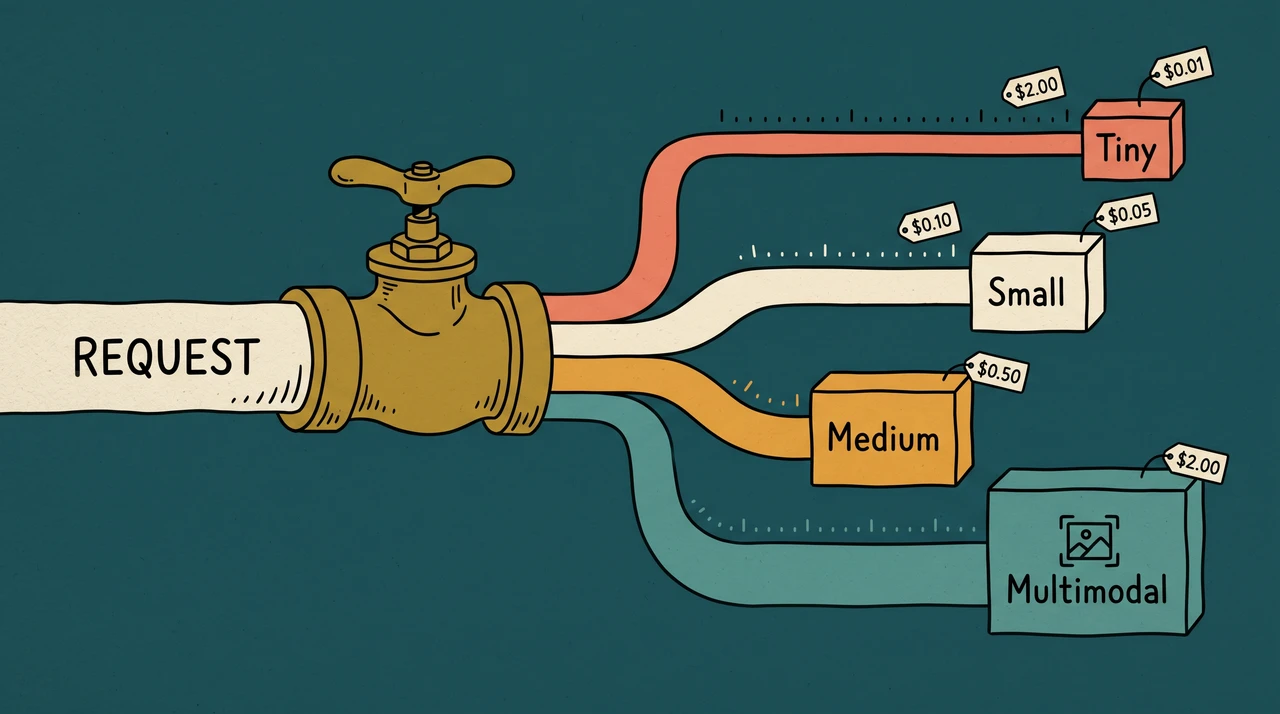
Pricing update (2026-08-17): DeepSeek moved the whole V4 family to peak/off-peak billing at 16:00 UTC on 2026-08-16. The DeepSeek rates quoted on this page are from before that change. Current rates, the multiplier on each tier, and the peak-hour windows are in DeepSeek API Price Increase. TL;DR — Put GLM-5.2, DeepSeek V4 (Pro and Flash), MiniMax M3, and Kimi K2.6 behind one ofox API key and route per task instead of paying one model’s price for every job. Blended per-token cost at a 2:1 input-to-output mix ranges from $0.19/M (V4 Flash) to $2.40/M (GLM-5.2) — a 12.86x spread. A worked 1,000-job/day routing table below cuts a $4,205/mo all-GLM bill to $1,453 (-65.5%). The routing rule is short: budget/batch → V4 Flash, long-context (up to 1M tokens) → V4 Pro or GLM-5.2, reasoning/code → GLM-5.2 or Kimi K2.6, images → MiniMax M3 or Kimi K2.6. All four sit on the same OpenAI-compatible endpoint, so routing is a one-string change — Python and Node loops included.
The mistake teams make is picking one model and running everything through it. A batch summarization job and a hard reasoning task do not deserve the same per-token price. With one key across all four models, the cheapest tier costs 12.86x less than the most capable one — so the entire game is matching each job class to the cheapest model that clears its quality bar.
This is a how-to with reproducible cost math, not a “which router is best” roundup. Every number below comes from ofox’s listed per-token rates verified June 23, 2026, and you can recompute each table from the spec sheet.
TL;DR: Which Model for Which Job?
One-line verdict: default your batch traffic to the cheapest tier and only escalate the jobs that need it. Here is the routing map by task shape.
| Task shape | Route to | ofox model ID | Why |
|---|---|---|---|
| Budget / high-volume batch | DeepSeek V4 Flash | deepseek/deepseek-v4-flash-0731 | $0.19/M blended, 12.86x cheaper than GLM-5.2 |
| Cost-sensitive general work | DeepSeek V4 Pro | deepseek/deepseek-v4-pro-0813 | $0.59/M blended, free cache reads, 1M context |
| Long-context (up to ~1M tokens) | V4 Pro or GLM-5.2 | deepseek/deepseek-v4-pro-0813 / z-ai/glm-5.2 | V4 Pro cheapest 1M input ($0.45/M); GLM-5.2 best reasoning at 1M |
| Hard reasoning / agentic coding | GLM-5.2 or Kimi K2.6 | z-ai/glm-5.2 / moonshotai/kimi-k2.6 | Strongest reasoning tier; Kimi K2.6 multimodal alternative |
| Image input (vision tasks) | MiniMax M3 or Kimi K2.6 | minimax/minimax-m3 / moonshotai/kimi-k2.6 | Only two of the four accept image_url; M3 is cheaper |
| Very long single output | DeepSeek V4 Pro/Flash | deepseek/deepseek-v4-pro-0813 | 384K max output, highest of the four |
The honest default for most 2026 teams: send the bulk of your traffic to deepseek/deepseek-v4-flash-0731 or deepseek/deepseek-v4-pro-0813, escalate the genuinely hard reasoning to z-ai/glm-5.2, and send anything with an image to minimax/minimax-m3. That covers the realistic 90% of mixed workloads behind one key with no vendor migration.
Quick Specs Comparison
Verified against the ofox /v1/models catalog on June 23, 2026. Prices are per million tokens.
| Spec | GLM-5.2 | DeepSeek V4 Pro | DeepSeek V4 Flash | MiniMax M3 | Kimi K2.6 |
|---|---|---|---|---|---|
| ofox model ID | z-ai/glm-5.2 | deepseek/deepseek-v4-pro-0813 | deepseek/deepseek-v4-flash-0731 | minimax/minimax-m3 | moonshotai/kimi-k2.6 |
| Context window | 1,048,576 | 1,000,000 | 1,000,000 | 1,131,000 | 262,144 |
| Max output | 128,000 | 384,000 | 384,000 | 131,000 | 262,144 |
| Input $/M | $1.40 | $0.45 | $0.14 | $0.60 | $0.95 |
| Output $/M | $4.40 | $0.88 | $0.28 | $2.40 | $4.00 |
| Cache read $/M | $0.26 | ~$0.00 | ~$0.00 | $0.12 | $0.16 |
| Modality | text | text | text | text + image | text + image |
Three structural facts drive every routing decision below:
- DeepSeek V4 Flash is the price floor. At $0.14/$0.28 it is 12.86x cheaper blended than GLM-5.2. Anything that does not need top-tier reasoning starts here.
- DeepSeek V4 cache reads are effectively free. Both V4 tiers bill cache reads at a rounding-to-zero rate, versus GLM-5.2’s $0.26/M. On repeated-context workloads this is a large, often-overlooked saving.
- Only MiniMax M3 and Kimi K2.6 take images. GLM-5.2 and both DeepSeek tiers are text-only. Vision tasks have exactly two valid routes, and MiniMax M3 is the cheaper of them.
Blended Cost: The Number That Drives Routing
A model’s headline input price is half the story. What you pay depends on your input-to-output ratio. A coding agent reads a lot (large context) and writes a little (a diff) — roughly 2:1 input-to-output. Chat is closer to 1:1. Pure code generation from a short prompt is output-heavy, around 1:3.
Here is the blended cost per million tokens at the coding-typical 2:1 mix (two-thirds input, one-third output), and the multiplier against GLM-5.2 as the reasoning-tier anchor:
| Model | Blended $/M (2:1) | vs GLM-5.2 |
|---|---|---|
| DeepSeek V4 Flash | $0.187 | 12.86x cheaper |
| DeepSeek V4 Pro | $0.593 | 4.04x cheaper |
| MiniMax M3 | $1.200 | 2.00x cheaper |
| Kimi K2.6 | $1.967 | 1.22x cheaper |
| GLM-5.2 | $2.400 | 1.00x (anchor) |
Pull quote: The cheapest model on this list costs 12.86x less than the most capable one. That spread is the entire economic case for routing — not which model “wins,” but which jobs can ride the cheap tier without anyone noticing.
The ranking shifts a little with workload shape. At 1:3 output-heavy (code generation), GLM-5.2 climbs to $3.65/M and Kimi K2.6 to $3.24/M, while V4 Flash stays at $0.245/M. Output-heavy work tilts even harder toward the DeepSeek tiers because their output token is the cheapest of the five. If you only remember one rule: the more your job writes, the more it pays to route off GLM-5.2 and Kimi K2.6.
If you want to stop estimating and measure these numbers on your own traffic, route all five models through one ofox key — pay-as-you-go, no monthly fee, same OpenAI SDK shape, and the A/B loop at the end of this post swaps models with a one-line string change.
Per-Task Cost: What One Agent Run Costs on Each Model
Routing decisions are easier to feel in per-run dollars than per-million-token rates. Take a representative agent run: 50,000 input tokens, 15,000 output tokens (read a chunk of a codebase, produce a change).
| Model | Cost per run (50K in / 15K out) |
|---|---|
| DeepSeek V4 Flash | $0.0112 |
| DeepSeek V4 Pro | $0.0357 |
| MiniMax M3 | $0.0660 |
| Kimi K2.6 | $0.1075 |
| GLM-5.2 | $0.1360 |
At 10,000 such runs a month, that is $112 on V4 Flash versus $1,360 on GLM-5.2 for the same work. If even half those runs are routine enough for the budget tier, the routing decision pays for itself many times over. The point is not that V4 Flash is always right — it is that paying GLM-5.2’s price for a job V4 Flash could handle is pure waste.
The Routing Decision Matrix (Worked Example)
Here is the part most “use a router” articles skip: the actual daily math. Assume 1,000 mixed jobs per day with this realistic distribution:
| Job class | Count/day | Tokens (in / out) | Routed to |
|---|---|---|---|
| Budget / batch | 600 | 10K / 2K | DeepSeek V4 Flash |
| Long-context | 250 | 300K / 8K | DeepSeek V4 Pro |
| Reasoning / code | 100 | 40K / 12K | GLM-5.2 |
| Multimodal (image) | 50 | 16.5K / 3K | MiniMax M3 |
Run everything on GLM-5.2 (the one-model trap) versus routing each class to its cost-appropriate model:
| Strategy | Daily cost | Monthly (×30) |
|---|---|---|
| All-GLM-5.2 baseline | $140.17 | ~$4,205 |
| Routed | $48.42 | ~$1,453 |
| Savings | $91.75/day | ~$2,753/mo (-65.5%) |
The breakdown of the routed total:
| Job class | Model | Daily cost |
|---|---|---|
| Budget / batch (600) | V4 Flash | $1.18 |
| Long-context (250) | V4 Pro | $35.51 |
| Reasoning / code (100) | GLM-5.2 | $10.88 |
| Multimodal (50) | MiniMax M3 | $0.85 |
| Total | $48.42 |
The 600 batch jobs — 60% of volume — cost $1.18/day on V4 Flash. On GLM-5.2 the same 600 jobs would cost about $13.68/day — roughly 11.6× more. That single routing rule (cheap batch → V4 Flash) does most of the work. The long-context class is where the dollars actually concentrate, which is why the next section matters.
flowchart TD
    A[Incoming request] --> B{Needs image input?}
    B -->|Yes| C[minimax/minimax-m3]
    B -->|No| D{Hard reasoning<br/>or agentic coding?}
    D -->|Yes| E[z-ai/glm-5.2]
    D -->|No| F{Context > 200K<br/>tokens?}
    F -->|Yes| G[deepseek/deepseek-v4-pro-0813<br/>free cache reads, 1M ctx]
    F -->|No| H[deepseek/deepseek-v4-flash-0731<br/>cheapest tier]
Cache Reads: DeepSeek V4’s Quiet Cost Advantage
The long-context class above is where caching changes the math. DeepSeek V4 Pro and Flash bill cache reads at effectively $0/M. GLM-5.2 bills them at $0.26/M, MiniMax M3 at $0.12/M, Kimi K2.6 at $0.16/M.
Take the 300K-input long-context job from the routing table (per-run cost includes 8K output), with 80% of the input served from cache (realistic for code-review loops where the same codebase context repeats across requests):
| Model | No cache | 80% input cache | Saving |
|---|---|---|---|
| DeepSeek V4 Pro | $0.1420 | $0.0340 | 76.0% |
| GLM-5.2 | $0.4552 | $0.1816 | 60.1% |
V4 Pro starts cheaper and saves a larger share, because its cache read rounds to zero while GLM-5.2 still pays $0.26/M on the cached portion. For any workload that re-sends the same long context — RAG over a fixed corpus, iterative code review, document Q&A — route to DeepSeek V4 Pro and the free cache read compounds. This is a routing input GLM-5.2’s stronger reasoning does not always justify overriding.
Splitting the Reasoning Tier: GLM-5.2 vs Kimi K2.6
The routing matrix sends “hard reasoning / agentic coding” to GLM-5.2 or Kimi K2.6, and that “or” deserves a rule rather than a coin flip. Both are the expensive end of this lineup — GLM-5.2 at $1.40/$4.40, Kimi K2.6 at $0.95/$4.00 — and on a 2:1 mix Kimi K2.6 actually blends slightly cheaper ($1.97/M vs $2.40/M) because its input rate is lower. Three concrete factors decide the route:
| Decision factor | Route to GLM-5.2 | Route to Kimi K2.6 |
|---|---|---|
| Context length needed | Up to 1,048,576 tokens | Caps at 262,144 — drop it for >256K jobs |
| Image input in the task | Not supported (text-only) | Supported (text + image) |
| Cheaper blended cost at 2:1 | $2.40/M | $1.97/M (18% lower) |
| Max single output | 128,000 tokens | 262,144 tokens |
The practical rule: if the reasoning job carries a large context (>256K tokens), GLM-5.2 is the only one of the two that fits — Kimi K2.6 will reject the input. If the context is comfortably under 256K and the job involves an image or wants the cheaper per-token rate, Kimi K2.6 is the better route. For most short-context agentic coding turns, Kimi K2.6’s lower input price makes it the value pick inside the reasoning tier; reserve GLM-5.2 for the long-context reasoning that only its 1M window can hold. The Kimi K2.6 release guide covers its agentic behavior in more depth.
This is exactly why client-side routing beats locking to one model: the “best reasoning model” depends on the shape of the reasoning job, and a model string is the cheapest possible switch between them.
Latency and Throughput Are Routing Inputs Too
Cost is the loudest routing signal, but not the only one. Two operational notes that change real routing decisions:
- Interactive vs batch. For a user-facing assistant where first-token latency is felt, the cheapest model is not automatically the right one — a slightly pricier model that returns faster can be worth it on the interactive surface, while overnight batch jobs should ride the cheapest tier regardless of speed. Route by surface, not just by price: interactive traffic tolerates a higher per-token cost, batch traffic does not.
- Output ceiling as a hard constraint. If a single response must exceed 128,000 tokens — full-file rewrites, large structured exports — GLM-5.2 and MiniMax M3 cap out and the call truncates. Only the DeepSeek V4 tiers (384K) and Kimi K2.6 (262K) clear that bar in one call. This is a binary routing gate, not a cost trade-off: send oversized-output jobs to a model that can physically emit the tokens.
Both of these are decisions your pick_model function can encode as plain conditionals — surface type and expected output size are usually known at request time.
When NOT to Route (and What to Use Instead)
Routing is not free engineering. Three cases where a multi-model split is the wrong move:
- Single developer, < 1,000 calls/day, all one task type. The routing logic and per-model quality testing cost more time than you save. Pick
deepseek/deepseek-v4-pro-0813as a strong, cheap default and move on. The $0.59/M blended cost is already low enough that micro-optimizing is not worth the branching code. - You actually need server-side automatic fusion. ofox routes by your
modelfield — it does not auto-pick a model or fuse outputs. If you specifically want quality-based auto-selection or response fusion (the OpenRouter Auto / Sakana-style idea), that is a different product category. Use one of those tools, or read our honest review of whether OpenRouter is reliable before deciding the auto-router is worth the unpredictability. - Every job genuinely needs top-tier reasoning. If your traffic is 100% hard agentic coding with no budget-tier work, there is nothing to route — run GLM-5.2 (or Kimi K2.6) and skip the matrix. Routing only pays when your workload is mixed. For a pure two-model reasoning split, our Claude Code hybrid routing pattern covers that narrower case.
The routing payoff is proportional to how heterogeneous your traffic is. Homogeneous traffic → one model. Mixed traffic → the matrix above.
Try It via ofox: Route All Five in One Loop
All five models share https://api.ofox.ai/v1 and one ofox key. Routing is a client-side decision: you set the model field per request. Here is the routing function and an A/B loop in both Python and Node.
Python — route by task, then A/B the candidates
from openai import OpenAI

client = OpenAI(base_url="https://api.ofox.ai/v1", api_key="<OFOXAI_API_KEY>")

def pick_model(task):
    if task["has_image"]:         return "minimax/minimax-m3"        # only M3/Kimi take images
    if task["hard_reasoning"]:                                       # split the reasoning tier
        return "z-ai/glm-5.2" if task["context"] > 256_000 else "moonshotai/kimi-k2.6"
    if task["context"] > 200_000: return "deepseek/deepseek-v4-pro-0813"  # free cache reads, 1M ctx
    return "deepseek/deepseek-v4-flash-0731"                              # cheapest tier

def run(task, messages):
    model = pick_model(task)
    return client.chat.completions.create(model=model, messages=messages)
To compare candidates on your own traffic, loop over the model IDs with a fixed prompt — swap the string, keep everything else constant:
CANDIDATES = ["deepseek/deepseek-v4-flash-0731", "deepseek/deepseek-v4-pro-0813", "z-ai/glm-5.2"]
for model in CANDIDATES:
    r = client.chat.completions.create(
        model=model,
        messages=[{"role": "user", "content": "Refactor this function for readability: ..."}],
    )
    u = r.usage
    print(model, u.prompt_tokens, u.completion_tokens)  # log tokens to price each route
Node — same shape
import OpenAI from "openai";

const client = new OpenAI({ baseURL: "https://api.ofox.ai/v1", apiKey: process.env.OFOXAI_API_KEY });

const pickModel = (t) =>
  t.hasImage        ? "minimax/minimax-m3"
  : t.hardReasoning ? (t.context > 256000 ? "z-ai/glm-5.2" : "moonshotai/kimi-k2.6")
  : t.context > 200000 ? "deepseek/deepseek-v4-pro-0813"
  : "deepseek/deepseek-v4-flash-0731";

const r = await client.chat.completions.create({
  model: pickModel(task),
  messages: [{ role: "user", content: "Summarize this changelog: ..." }],
});
Multimodal only: attach a screenshot to MiniMax M3 or Kimi K2.6
GLM-5.2 and both DeepSeek tiers are text-only — the call below physically fails on them. Route image input to minimax/minimax-m3 or moonshotai/kimi-k2.6:
import base64

img = base64.b64encode(open("screenshot.png", "rb").read()).decode()
r = client.chat.completions.create(
    model="minimax/minimax-m3",   # or moonshotai/kimi-k2.6
    messages=[{"role": "user", "content": [
        {"type": "text", "text": "What error is shown in this screenshot?"},
        {"type": "image_url", "image_url": {"url": f"data:image/png;base64,{img}"}},
    ]}],
)
That is the whole router: a pick_model function and one OpenAI client. No new SDK, no per-model API key, one billing line. Detail pages for each model are linked in the table — z-ai/glm-5.2, deepseek/deepseek-v4-pro-0813, deepseek/deepseek-v4-flash-0731, minimax/minimax-m3, and moonshotai/kimi-k2.6.
Alternatives
If a single-key, client-side router fits your workload, ofox is the simplest path: one OpenAI-compatible endpoint, one balance, all five model IDs. For other shapes:
- ofox — one key, 100+ models, OpenAI-compatible. You control routing via the
modelfield; billing and the endpoint are unified. Best when you want cost-predictable, deterministic routing you write yourself. See the OpenRouter alternatives breakdown for how it compares on markup and reliability. - OpenRouter — large catalog with an optional
Autoserver-side router that picks a model for you. Useful if you specifically want automatic selection and can tolerate less predictable routing and the platform’s markup. - Direct provider APIs — calling DeepSeek, Zhipu (GLM), MiniMax, and Moonshot each directly gives you the rawest pricing but four keys, four SDKs, and four billing lines to reconcile. Worth it only at very high single-provider volume.
- Self-hosting — GLM and DeepSeek publish open weights, so an air-gapped or fork-required deployment is possible. The economics only work at scale; see our GLM-5.2 self-host hardware cost analysis for the breakeven math against hosted per-token pricing.
For deeper per-model context, the GLM-5.2 access guide, GLM-5.2 vs GPT-5.5 cost breakdown, DeepSeek V4 Pro vs Flash comparison, DeepSeek V4 release guide, and MiniMax M3 vs GPT-5.5 coding benchmark each go one layer deeper than this routing overview.
FAQ
The frontmatter FAQ block above answers the most common routing questions (one-key routing, cheapest model, longest context, which models do vision, real savings, free cache reads, no server-side auto-router, max output, and how to A/B). Those answers mirror the tables in this post — the cost numbers, model IDs, and routing rules are consistent throughout.
References
- ofox
/v1/modelslive API catalog — all five model IDs, context windows, max output, and per-token pricing (input / output / cache read) verified 2026-06-23 - ofox
llms-full.txt— OpenAI-compatible base_urlhttps://api.ofox.ai/v1 - ofox model detail pages for
z-ai/glm-5.2,deepseek/deepseek-v4-pro-0813,deepseek/deepseek-v4-flash-0731,minimax/minimax-m3,moonshotai/kimi-k2.6— all returned HTTP 200 (2026-06-23) - OpenAI Python SDK (
openai2.43.0 on PyPI) and OpenAI Node SDK — SDK shape used in code examples (2026-06-23) - All cost tables are recomputable from the per-token rates in the Quick Specs table
Frequently Asked Questions
- Can I route between GLM-5.2, DeepSeek V4, MiniMax M3, and Kimi K2.6 with one API key?
- Yes. All four live on the same OpenAI-compatible endpoint at https://api.ofox.ai/v1. A single ofox key authenticates every model — you route by changing the
modelstring per request:z-ai/glm-5.2,deepseek/deepseek-v4-pro-0813,deepseek/deepseek-v4-flash-0731,minimax/minimax-m3, ormoonshotai/kimi-k2.6. Same key, same SDK, one balance. There is no server-side auto-router; your client picks the model per task. - Which model is cheapest per token?
- DeepSeek V4 Flash at $0.14 input / $0.28 output per million tokens — a $0.187/M blended cost at a 2:1 input-to-output mix, 12.86x cheaper than GLM-5.2's $2.40/M blended. DeepSeek V4 Pro is next at $0.45/$0.88 ($0.593/M blended). MiniMax M3 is $0.60/$2.40 ($1.20/M), Kimi K2.6 is $0.95/$4.00 ($1.97/M), and GLM-5.2 is $1.40/$4.40, the most expensive of the four but the strongest on reasoning.
- Which model has the longest context window?
- MiniMax M3 at 1,131,000 tokens, just ahead of GLM-5.2 at 1,048,576 and DeepSeek V4 (Pro and Flash) at 1,000,000. Kimi K2.6 is the outlier at 262,144 tokens. For jobs that need a full 1M-token input — large monorepo refactors, long-document analysis — route to V4 Pro (cheapest 1M-class input at $0.45/M) or GLM-5.2 (best reasoning at 1M).
- Which of these models handle images?
- Two of the four: MiniMax M3 and Kimi K2.6 accept text plus image input. GLM-5.2 and both DeepSeek V4 tiers are text-only — sending them an
image_urlcontent block will fail. Route any vision task to MiniMax M3 (cheaper, $0.60/$2.40, 1.131M context) or Kimi K2.6 ($0.95/$4.00) and keep text-only jobs on the cheaper DeepSeek tiers. - How much does routing actually save versus running everything on one model?
- In the worked example below — 1,000 mixed jobs per day across budget, long-context, reasoning, and multimodal work — running everything on GLM-5.2 costs about $140.17/day ($4,205/mo). Routing each job class to its cost-appropriate model drops that to $48.42/day ($1,453/mo), a 65.5% reduction. The savings come from sending the 600 cheap batch jobs to V4 Flash instead of paying GLM-5.2's premium for work that does not need it.
- Does DeepSeek V4's free cache read actually matter?
- Yes, on repeated long-context jobs. DeepSeek V4 Pro and Flash both bill cache reads at effectively $0/M (the listed rate is $0.0000037/M, rounding to zero). On a 300K-input job at 80% cache hit, V4 Pro drops from $0.142 to $0.034 per run — a 76% input saving. GLM-5.2's cache read is $0.26/M, so the same job saves only 60.1%. For code-review loops where the same codebase context repeats, V4 Pro's free cache read compounds fast.
- Is there a server-side automatic router on ofox?
- No. ofox is an OpenAI-compatible proxy: one base_url, one key, 100+ models. Routing is a client-side decision — your code sets the
modelfield per request based on the task. Automatic model fusion or quality-based auto-routing (the OpenRouter Auto or Sakana-style fusion idea) is a separate product category; ofox gives you the unified billing and endpoint, you keep control of which model runs. That is usually what you want for cost-predictable production routing. - What is the max output token limit on each model?
- DeepSeek V4 Pro and Flash lead at 384,000 max output tokens, Kimi K2.6 at 262,144, GLM-5.2 at 128,000, and MiniMax M3 at 131,000. If you generate very long single responses — full-file rewrites, large structured outputs — the DeepSeek tiers give the most headroom in one call. For most agent loops the per-call output cap is rarely the binding constraint; cost-per-token is.
- Can I A/B these models on my own workload before committing?
- Yes, and you should. Because all four share one endpoint and key, an A/B harness is a Python loop over a list of model IDs — swap the string, keep the prompt fixed, log tokens and latency. The 10-line loop at the end of this post runs the same task across
deepseek/deepseek-v4-flash-0731,z-ai/glm-5.2, and the rest, so you measure real cost on your traffic instead of trusting a blended estimate.