Agentic Coding in 2026: Claude Code vs Codex CLI vs Gemini CLI vs Cursor Agent
The four agentic coding CLIs that actually matter in mid-2026 — Claude Code, Codex CLI, Gemini CLI, and Cursor Agent.
 Ofox
Ofox 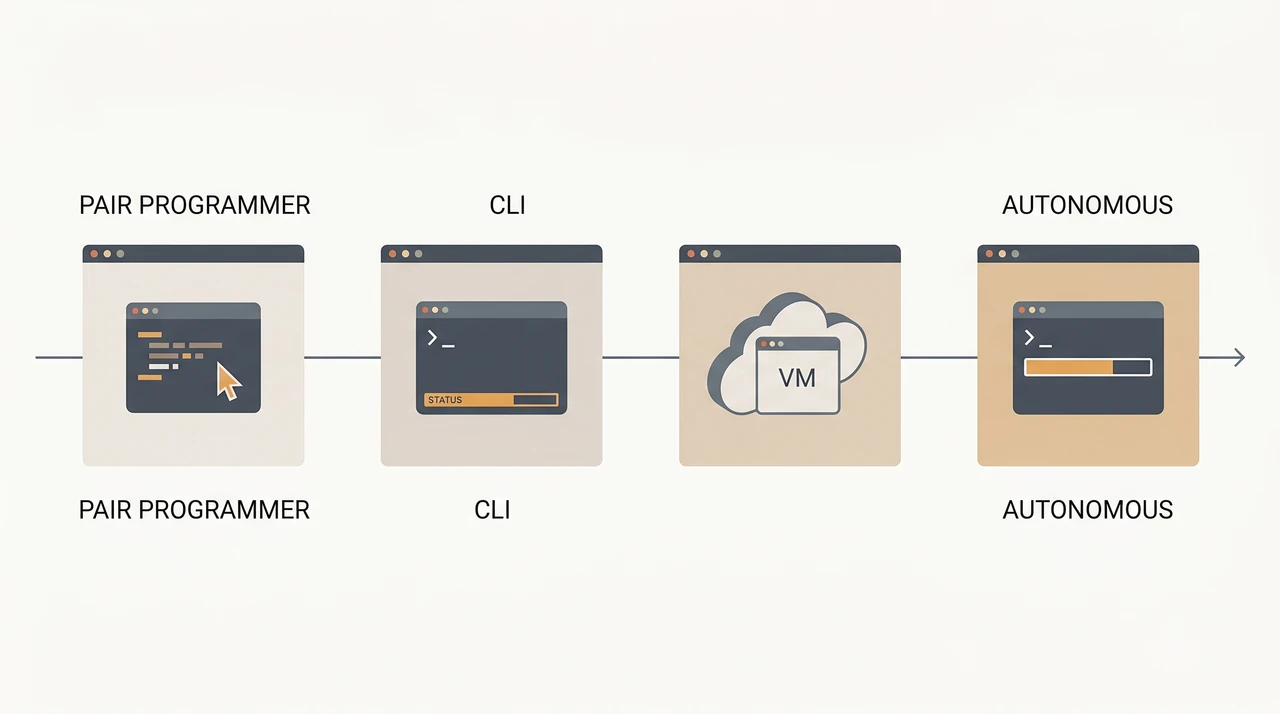
TL;DR: Agentic coding in mid-2026 is no longer a single category. Claude Code is the in-terminal pair programmer that wins on output quality. Codex CLI is the autonomy champion — Goal mode runs for hours without supervision and GPT-5.5 scores 82.7% on Terminal-Bench 2.0. Gemini CLI is being absorbed into Antigravity CLI on June 18, 2026, so plan migrations accordingly. Cursor Agent is the only one that ships background agents with a real browser and desktop, fanning out up to eight parallel jobs against a cloud VM. The right answer is not “pick one” — it is “pick where on the autonomy axis your task lives, then pick the agent that lives there too.”
The defining shift in 2026 agentic coding is not better models — it is that the agent left the terminal. Codex runs unattended for hours. Cursor agents click through browsers in cloud VMs. Gemini CLI itself is being deprecated in favor of a full desktop platform. If you are still using these tools the way you used Copilot in 2024, you are leaving 80% of the autonomy on the table.
What changed in 2026 for agentic coding CLIs
Agentic coding stopped meaning “the model writes a function for you” and started meaning “the model owns a multi-step task from spec to verified output.” Four mature CLIs now occupy that space, and each picked a different point on the autonomy spectrum.
- Claude Code (Anthropic) stayed close to the human. It runs in your terminal, asks for approval on edits, exposes hooks and subagents for extension, and treats the developer as the principal driver.
- Codex CLI (OpenAI) went the other direction. GPT-5.5 launched in April 2026 alongside CLI versions 0.124–0.125, Goal mode left preview, and OpenAI ran demos of 1,000+ sequential tool calls without intervention.
- Gemini CLI (Google) sat between them — a conversational ReAct loop CLI with a 1M-token window — until Google announced on May 12, 2026 that Gemini CLI is being transitioned to Antigravity CLI, with the cutoff for Google AI Pro/Ultra and free Gemini Code Assist on June 18, 2026.
- Cursor Agent (Cursor) went furthest from the terminal entirely. Background Agents in Cursor v3 run on a cloud VM with its own desktop, browser, and the ability to verify UI changes visually. February 2026 added the desktop-environment-per-agent upgrade, and you can fan out up to eight parallel agents.
The category fragmented because the question changed. It is no longer “which model is best at code” — it is “how much do I trust this agent for how long, and where should it run.”
The five-minute decision matrix
| CLI | Autonomy bet | Where it runs | Best paired model | Killer feature | Worst friction |
|---|---|---|---|---|---|
| Claude Code | Approval-gated, pair programmer | Local terminal | Claude Opus 4.7 / Sonnet 4.6 | Hooks + subagents + Skills, PostToolUse output replacement (May 2026) | Subscription throttle hits Pro tier fast |
| Codex CLI | Unattended Goal mode, hours-long | Local CLI or headless | GPT-5.5 (or via ofox: GPT-5.4 Pro, GPT-5.3 Codex) | Goal mode GA, 82.7% on Terminal-Bench 2.0, remote computer use | Less idiomatic on one-shot prompts |
| Gemini CLI | Conversational ReAct loop | Local terminal (sunsetting June 18) | Gemini 3.1 Pro / 3.1 Flash | 1M context, free tier (60 RPM / 1000 RPD), MCP support | Being merged into Antigravity CLI |
| Cursor Agent | Cloud-VM background fleet | Editor + cloud VM | Composer 2 (Cursor’s own) or Claude / GPT / Gemini | Background Agents with desktop + browser per agent, 8x parallel fan-out | Credit-based billing on premium model pins |
If you only read one row of that table: Claude Code for craftsmanship, Codex CLI for endurance, Gemini CLI for free-tier exploration (but plan the Antigravity migration), Cursor Agent for parallelism. The rest of the article explains why.
Claude Code: the pair-programmer model of agentic coding
Claude Code’s bet is that the developer should stay in the loop. The CLI lives in your terminal, runs against your local filesystem, asks for permission before destructive edits, and exposes the agent’s state through /context and /cost introspection commands. Claude Opus 4.7 is the default behind it as of May 2026 (Fast mode upgraded from Opus 4.6 earlier in the month), and Sonnet 4.6 covers the long tail at lower cost.
The 2026 extensibility story is what separates Claude Code from a fancier chat interface. Three layers do the work:
- Hooks fire shell commands at lifecycle events — PreToolUse, PostToolUse, Stop, SubagentStop, SessionStart. As of May 2026, PostToolUse hooks can replace tool output for all tools via
hookSpecificOutput.updatedToolOutput, not just MCP tools. That is how teams enforce “run tests before stop,” “block edits to generated files,” “require an issue ID in the branch name.” - Subagents let one Claude Code session spawn focused workers with their own context window, prompt, and tool permissions. The main agent owns planning; specialist subagents handle bounded tasks like code review or security scanning.
- Skills package reusable expertise — a Skill is a markdown file plus optional scripts that Claude Code loads when relevant. Teams ship Skill bundles the way they ship internal libraries.
The shape of a Claude Code session reflects the autonomy bet: short turns, frequent approvals, fine-grained control. You can let it run unattended, but the design pushes toward human-in-the-loop. For the deep dive on this extensibility stack see the Claude Code hooks, subagents, and skills complete guide and the ofox configuration guide.
The headache is the same one it has had all year. Pro at $20/month buys you Claude Code with a hard ceiling. Max 5x at $100 and Max 20x at $200 raise the ceiling but do not remove it. If your workflow is “set the agent and walk away for two hours,” Claude Code’s economics fight you. That is exactly the gap Codex CLI is built to fill.
Codex CLI: the autonomy champion
Codex CLI is what you reach for when the task duration is measured in hours, not minutes. The May 2026 changelog confirms the position: Goal mode left experimental status and is now GA across the Codex app, IDE extension, and CLI. With Goal mode, Codex drives toward a specific objective for hours or even days. The OpenAI demonstration of 1,000+ sequential tool calls on real software engineering tasks without intervention, combined with Terminal-Bench 2.0 scores of 82.7% on GPT-5.5, is the empirical answer to “can an agent actually finish.”
Remote computer use is the May 2026 feature that crystallizes the autonomy bet: Codex can use your Mac’s desktop apps even after the screen locks, including remotely via Codex Mobile. The safeguards — short-lived authorization tokens, covered displays, relock on local input, manual-unlock fallback — are real but the philosophy is clear. The agent does not need you watching.
Codex CLI 0.125.0 added reasoning-token usage reporting in codex exec --json, which closes a real observability gap. Until then, predicting how much a long Goal-mode run would cost was guesswork. With token-level reporting and OpenTelemetry traces, you can now budget multi-hour sessions with the kind of accuracy production workloads need.
Two trade-offs worth naming. First, Codex’s edits are slightly less idiomatic than Claude’s on first-pass quality, especially on tight refactors. Pair it with GPT-5.4 Pro through ofox or GPT-5.3 Codex if GPT-5.5 is not yet on your aggregator path. Second, Codex CLI is OpenAI-flavored — its tool-calling format, prompt conventions, and trace output mirror OpenAI’s wider stack. If your shop runs primarily on Anthropic models, Claude Code feels more native.
For day-to-day patterns see the Codex CLI real-world workflow guide and the official Codex installation guide.
Gemini CLI: the conversational ReAct loop (and its June 18 deadline)
Gemini CLI’s design is the simplest of the four — a reason-and-act loop with built-in tools (Google Search grounding, shell, file ops, web fetch) and MCP support for custom integrations. It exposes Gemini’s 1M-token context window directly in the terminal, and the free tier (60 requests/min, 1,000 requests/day on a personal Google account) is unmatched. For a year, Gemini CLI was the right answer for “I want to try agentic coding for free, with a serious context window.”
That story is changing. On May 12, 2026, Google announced that Gemini CLI and the Gemini Code Assist IDE extensions will stop serving requests for Google AI Pro and Ultra, as well as the free Gemini Code Assist for individuals tier, on June 18, 2026. Google is consolidating into Google Antigravity — an agent-first development platform that includes a server-side harness and a new terminal experience called Antigravity CLI.
What this means concretely:
- If you use Gemini CLI on a personal Google account for free: migrate to Antigravity CLI by June 18. The free tier moves with you.
- If you use Gemini CLI with a paid Google AI Pro or Ultra subscription: same migration.
- If you use Gemini CLI with your own API key (Gemini API key from AI Studio or Vertex): open-source Gemini CLI usage continues, but it is no longer Google’s recommended path. The community fork lives on; the corporate lane goes to Antigravity.
The migration is not a deprecation of agentic coding on Gemini — it is a re-platforming. Gemini 3.1 Pro and Gemini 3.1 Flash, both available on ofox today, remain the underlying models. For background on what Antigravity actually is, the Google Antigravity explainer covers the desktop-platform angle. For Gemini API specifics see the Gemini 3.1 Pro API guide and Gemini 3.5 Flash for coding and agents.
When Gemini CLI still wins (until June 18): free-tier exploration, MCP server prototyping with a generous context window, anything where you want to test agentic patterns without a paid subscription. After June 18, the answer shifts to Antigravity CLI for paid users and the open-source community fork for BYO-key users.
Cursor Agent: the fleet model
Cursor Agent is the outlier because Cursor refused to be a terminal. Where the other three agents are CLI-first, Cursor is editor-first — and in 2026 it pushed agents one step further, into a cloud VM with its own desktop and browser.
Background Agents (Cursor v3, with major February 2026 upgrades) are the headline feature. The mechanic: Cursor clones your repo into a cloud VM, an agent works on a dedicated branch with full desktop and browser access, and the result lands as a pull request. You keep editing locally while the agent runs. The February 2026 upgrade added desktop-per-agent — each Background Agent gets its own full development environment with a browser and the ability to interact with UI elements. Agents can open browsers, navigate to localhost, click through UI elements, and verify their code changes actually work visually before opening the PR.
You can fan out up to eight parallel background agents. For dependency upgrades across services, test backfills, or “the same small change across many repos,” this is genuinely different from anything the other three CLIs offer. The cost is real — each Background Agent burns Cursor credits — but the parallelism unlock is unique.
Cursor’s foreground story matters too. Composer 2, Cursor’s first-party model tuned for agentic coding, is advertised as roughly 4x faster than peer frontier models, with most agent turns finishing in under 30 seconds. Cursor shipped a successor — Composer 2.5 — on May 18, 2026, scoring 79.8% on SWE-Bench Multilingual; see the Composer 2.5 setup guide for the Fast vs Standard pricing trap and how it compares to Opus 4.7 on CursorBench. Auto mode does not consume credits; you only spend the credit pool when you pin a premium model like Claude Sonnet 4.6 or GPT-5.5. On the $20 Pro plan that translates to about $20 worth of credits per month plus unlimited Tab completions.
When Cursor Agent wins: you live in an editor more than a terminal, you have boring high-volume work that benefits from fan-out (dep upgrades, test backfills, find-and-replace at scale), or you need agents to verify UI changes visually. See the Cursor / Claude Code / Cline custom-API setup for combining Cursor Agent with a terminal agent in the same workflow.
The use-case matrix
| Your task | Best primary | Fallback | Why |
|---|---|---|---|
| Hard refactor, high quality, you watch | Claude Code (Opus 4.7) | Cursor Agent | Approval-gated, best idiomatic output |
| Multi-hour unattended task | Codex CLI Goal mode | Cursor Background Agent | Designed for walk-away autonomy |
| Browser-based UI verification needed | Cursor Background Agent | Codex remote computer use | Desktop + browser per agent |
| Eight-way parallel fan-out (dep upgrades) | Cursor Background Agents | Codex CLI scripted | Native parallelism |
| Free-tier experimentation (pre-June 18) | Gemini CLI | Cursor Hobby | 1M context, no card |
| Free-tier experimentation (post-June 18) | Antigravity CLI | Gemini CLI BYO-key | Where the free tier moved |
| Local-only, no cloud VMs allowed | Claude Code or Codex CLI | Gemini CLI BYO-key | Both stay on your machine |
| MCP-heavy custom tool stack | Claude Code | Gemini CLI | Most mature MCP integration |
| Headless / CI integration | Codex CLI | Claude Code in --print mode | Remote-control entrypoint, OpenTelemetry |
| Strict $30/month budget total | DeepSeek TUI + Cursor Hobby | Gemini CLI free tier | See $30/month coding stack |
This matrix sits next to the Claude Code vs Codex CLI vs Cursor vs DeepSeek TUI comparison, which covers the price-disruptor angle through DeepSeek TUI; this article covers the autonomy-depth angle through Gemini CLI’s Antigravity transition. Read both if you are picking a stack from scratch.
How to configure all four against one API key
The under-discussed fact about 2026 agentic coding is that you do not need four separate billing dashboards. Each CLI accepts a custom endpoint, and an aggregator like ofox.ai exposes Anthropic, OpenAI, and Google models through compatible APIs.
Claude Code with Anthropic-compatible endpoint:
export ANTHROPIC_BASE_URL="https://api.ofox.ai/anthropic"
export ANTHROPIC_API_KEY="sk-ofox-..."
claude
Codex CLI with OpenAI-compatible endpoint:
export OPENAI_BASE_URL="https://api.ofox.ai/v1"
export OPENAI_API_KEY="sk-ofox-..."
codex
Gemini CLI with Vertex-compatible endpoint (until June 18, then Antigravity equivalent):
export GOOGLE_GENAI_USE_VERTEXAI=false
export GEMINI_API_KEY="sk-ofox-..."
export GEMINI_API_BASE_URL="https://api.ofox.ai/gemini"
gemini
Cursor Agent reads custom endpoints from its settings panel — Settings → Models → Add Custom Model — and accepts any OpenAI-compatible base URL plus an API key. Set it to https://api.ofox.ai/v1 and you can call Claude, GPT, and Gemini through the same auth Cursor already speaks.
The pattern lets you run all four agents against the same model catalog and switch by task class, paying only for the tokens you actually consume. For the gateway reasoning behind this see the AI API aggregation guide, and for budget-shaping tactics across multiple agents see how to reduce AI API costs and the LLM API selection decision matrix.
What none of the four does well yet
The honest disclosure section. All four agentic CLIs have shared gaps in May 2026:
- Cross-repo awareness. All four operate within one repository at a time. Working across a monorepo plus three sibling repos still requires you to be the coordinator.
- Cost predictability before execution. Even with
/costand Codex’s token reporting, predicting “how much will this Goal-mode run cost” remains guesswork until the run finishes. - Persistent memory across sessions. Subagents and Skills help with reusable knowledge, but no agent in this comparison genuinely remembers what it did last Tuesday without your prompt scaffolding.
- Reliable test-driven loops. Write-test-then-code-then-iterate works for green-field code but breaks down on flaky tests or 20-minute CI cycles.
- Verification on non-UI work. Cursor’s browser-equipped Background Agents can visually verify UI changes. For data-pipeline correctness or distributed-system invariants, all four still rely on tests you wrote.
If any of these matter more than the per-CLI differences in the table above, the right move is to architect around the gap (CI-side verification harnesses, persistent memory in your own store) rather than wait for one of the agents to grow into it.
Closing recommendation
Pick by autonomy axis first, then by ecosystem fit.
- You want a craftsman pair programmer in the terminal: Claude Code with Opus 4.7. Use Sonnet 4.6 for the long tail.
- You want walk-away autonomy for hours: Codex CLI Goal mode with GPT-5.5 (or GPT-5.4 Pro through ofox if GPT-5.5 is not yet on your aggregator).
- You want free-tier exploration before June 18: Gemini CLI today. Migrate to Antigravity CLI by mid-June.
- You want browser-aware parallel agents in a cloud VM: Cursor Background Agents, up to eight in parallel.
The interesting workflow most production teams will land on in late 2026 is not picking one. It is running Claude Code locally for craftsmanship, Codex CLI in a separate shell for endurance, and Cursor Background Agents in the cloud for fan-out — all three pointing at one API gateway so you have one bill and one model catalog.
Stop debating which agentic CLI is best — they specialize. The 2026 production stack is Claude Code for craftsmanship, Codex CLI for endurance, and Cursor Background Agents for parallelism, all routed through one API key. The developers shipping fastest are not choosing; they are composing.
For deeper benchmarks see the LLM leaderboard, the best LLM for coding ranked by real use, and the GPT-5.5 vs Claude Opus 4.7 vs Gemini 3.1 Pro benchmark for the model-side picture behind these CLIs.
Sources and version stamps
- Claude Code: PostToolUse output replacement for all tools (May 2026), Fast mode default upgraded to Opus 4.7 (was 4.6) per Anthropic release notes and ClaudeLog, May 2026
- Codex CLI: v0.124.0 quick reasoning controls, v0.125.0 reasoning-token reporting in
codex exec --json, Goal mode GA, remote computer use, per OpenAI developers changelog; GPT-5.5 Terminal-Bench 2.0 score of 82.7% per OpenAI GPT-5.5 launch announcement - Gemini CLI → Antigravity CLI: transition announcement May 12, 2026; cutoff for Google AI Pro/Ultra and free Gemini Code Assist on June 18, 2026, per Google Developers Blog “Transitioning Gemini CLI to Antigravity CLI”
- Cursor Agent: Background Agents shipped in v3.0 with cloud VMs, February 2026 upgrade adding desktop + browser per agent, fan-out to 8 parallel agents, Composer 2 as first-party model, per cursor.com/product and Cursor v3 release notes
- ofox model availability: Claude Opus 4.7, Sonnet 4.6, Haiku 4; GPT-5.4 Pro, GPT-5.4, GPT-5.3 Codex; Gemini 3.1 Pro, 3.1 Flash, 3.1 Flash-Lite — verified at ofox.ai/llms-full.txt on 2026-05-25
Frequently Asked Questions
- What is agentic coding and how is it different from AI autocomplete?
- Agentic coding lets a model plan, run tools (shell, file edits, web fetches), check its own output, and iterate without you driving every step. Autocomplete completes the next token; an agent finishes the whole task. In 2026 the four mainstream entry points are Claude Code, Codex CLI, Gemini CLI, and Cursor Agent — each makes a different bet on how much autonomy you grant per session.
- Is Gemini CLI being shut down?
- It is being merged into Antigravity CLI as of June 18, 2026. Google AI Pro and Ultra users plus the free Gemini Code Assist tier will be migrated to Google Antigravity, an agent-first platform with a server-side harness and a new terminal experience. Open-source Gemini CLI usage with your own API key continues but is no longer the recommended path.
- Which agentic CLI handles the longest autonomous runs?
- Codex CLI with GPT-5.5 in Goal mode. OpenAI demonstrated 1,000+ sequential tool calls and Terminal-Bench 2.0 scores of 82.7%. Cursor Background Agents come second because they run on a cloud VM with their own desktop and browser, but Codex still leads on uninterrupted single-task duration.
- Can I run all four CLIs against one API key?
- Yes, if the CLI exposes a custom base URL. Claude Code accepts ANTHROPIC_BASE_URL, Codex CLI accepts OPENAI_BASE_URL, Gemini CLI accepts a Vertex or OAI-compatible config, and Cursor Agent takes a custom endpoint per workspace. Pointing all four at an aggregator like ofox.ai gives you one key for Claude Opus 4.7, GPT-5.5, Gemini 3.1 Pro, and the open-weight models, with billing in one place.