Best AI Coding Agent Harness (2026): 9 Tools + Model Pairing
Compare nine coding agent harnesses, their model and protocol choices, and a dated hands-on test. Includes October updates to usage data, Copilot BYOK and Pi MCP.
 Ofox
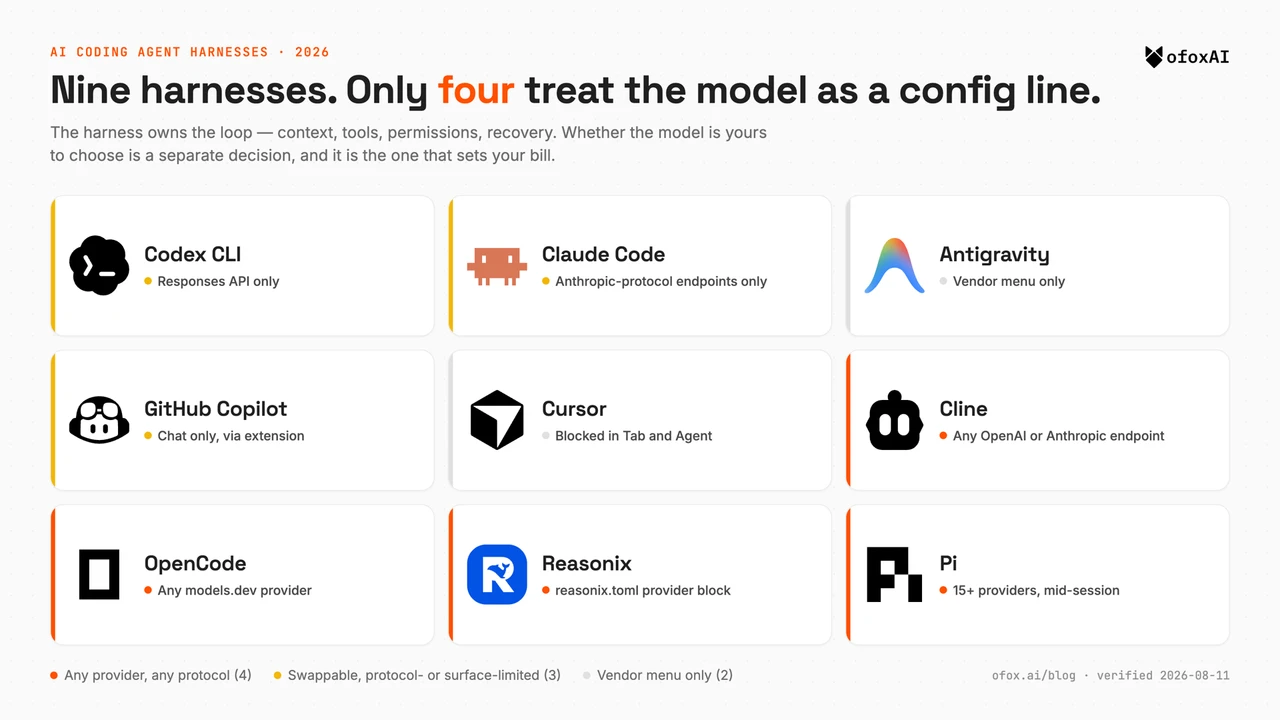
An AI coding harness is the software around a model that handles context, tools, permissions, retries and session state. Choose that workflow first, then verify the model and API protocol it supports. This guide compares nine tools; it is not a benchmark that establishes one universal winner. Ofox publishes this article and provides an API gateway, so its integration links are commercial next steps, not independent endorsements.
October 20 update: We rechecked the four OpenRouter app pages, Copilot BYOK documentation, Cursor’s API-key documentation and Pi’s current feature page. The old opening claim that GLM 5.2 leads Claude Code usage is no longer current: Claude Opus 5.5 now leads the displayed monthly list. Copilot supports more BYOK clients, and Pi now includes MCP. The original August hands-on runs and screenshots remain historical evidence; we did not rerun those model/tool pairs. The original cover graphic also predates these capability corrections.
TL;DR: Which Harness Should You Pick?
| Harness | Where it runs | Price | Swap the model? | Extends with | License |
|---|---|---|---|---|---|
 Codex CLI | Terminal | ChatGPT plan or API key | Responses API only | AGENTS.md, MCP | Apache-2.0 |
 Claude Code | Terminal | Claude plan or API key | Yes, ANTHROPIC_BASE_URL | Hooks, subagents, skills, MCP | Proprietary |
 Google Antigravity | Desktop, IDE, CLI | Free tier for developers | No custom route tested in August CLI | Agent manager, subagents | Proprietary |
 GitHub Copilot | IDE, CLI, cloud | Plan allowance; BYOK separate | Local BYOK in supported clients; enterprise policies apply | Skills, MCP | Proprietary |
 Cursor | IDE | Subscription | Supported chat models; Tab excluded | Rules, MCP | Proprietary |
 Cline | VS Code, JetBrains | BYO key | Compatible OpenAI / Anthropic routes; verify tools | Plan mode, MCP | Apache-2.0 |
 OpenCode | Terminal, desktop | BYO key | Yes, any models.dev provider | AGENTS.md, MCP | MIT |
 Reasonix | Terminal, desktop, VS Code | BYO key | Yes, reasonix.toml | MCP, sidecars, plan mode, checkpoints | MIT |
 Pi | Terminal, RPC, SDK | BYO key | Yes, 15+ providers, mid-session | Extensions, skills, MCP and Codemode | MIT |
A custom key, a custom endpoint and a working agent loop are three different capabilities. Check the exact client, account policy, API protocol and tool behavior; a model appearing in a picker does not prove that file edits, tool calls or retries work. The prices and remaining product descriptions below retain their original comparison context unless an October update is identified; use current vendor documentation before buying a plan.
What Is an AI Coding Agent Harness?
A harness is the program wrapped around a model that turns token generation into work on your repository. The model is the engine. The harness is the transmission, the chassis, and the brakes.
Concretely, the harness owns five jobs the model cannot do for itself. It assembles context, deciding which files and prior turns get sent. It defines and executes tools, so a read_file call actually reads a file. It gates permissions, so a rm -rf either runs, prompts, or is refused. It manages recovery, deciding what happens when a patch fails to apply or a test goes red. And it holds session state, so an interrupted run can resume instead of starting cold.
This is why two developers running the same model report wildly different experiences. Swap GPT-5.6 Sol from Codex into Cline and the model is identical while the file-reading strategy, the tool schema, the retry policy, and the approval flow all change. The category name people search for varies (agent harness, coding agent, AI coding tool) but they are describing the same layer.
How Do These Harnesses Actually Differ?
Four axes separate them, and only the fourth is hard to see before you commit.
Where it runs. Terminal-first (Codex, Claude Code, OpenCode, Reasonix, Pi), inside an editor (Cline, Cursor, Copilot), or as a standalone agent manager with its own window (Antigravity 2.0). This decides whether you can pipe it, cron it, or run it over SSH.
Whether the model is yours to choose. The cleanest binary in the category. Either the tool reads a base URL from config, or the model menu is the vendor’s and that is the end of it.
What extends it. Hooks and subagents and skills and MCP servers, versus a deliberately bare loop you build on. Claude Code and Pi sit at opposite ends of this on purpose.
How the control loop behaves under stress. The one that decides whether you keep using the thing. Does it read the right files before editing, keep the diff scoped, run your checks, recover from a failed test without thrashing, and resume after an interruption? A long r/AI_Agents thread on harness selection from July 2026 converged on exactly this, and the top comment put it better than we could:
People often over-index on the model and under-index on the execution loop.
That is the framing this article follows. Model quality is table stakes now. Loop behaviour is another differentiator; model scores alone do not describe it.
Original August test: how we tested the loop
Since loop behaviour is the claim, we ran one. We built a small Python repo containing a real bug: a retry helper catches urllib.error.HTTPError, while the OpenAI SDK raises openai.RateLimitError, so the 429 branch never fires and the test fails. Six of the nine tools here (Codex CLI, Claude Code, Cline, OpenCode, Reasonix, and Pi) were pointed at the same gateway and given the identical prompt in the identical repo: run the test, name the one-line root cause, show the fix as a unified diff, edit nothing.
All six named the root cause correctly, which is the least interesting finding and the one to state first. The differences showed up underneath. Codex CLI, OpenCode, and Cline ran the test before answering; Claude Code, Reasonix, and Pi answered from reading the code. On the dead import urllib.error the fix leaves behind, Codex called it out in prose and Claude Code quietly dropped it in the diff; the other four left it in place. And four of the six shipped a patch that still contains the if e.code != 429 guard. Three wrote it out explicitly and one left it untouched by changing only the except line. That guard can never pass once you are catching openai.RateLimitError: its .code is the API’s string error code, never the HTTP status (that lives in .status_code), so e.code != 429 is always true and the retry path is unreachable.
That last one is a model artefact more than a harness one, which is exactly the point: the harness decides whether the loop verifies its own patch, and none of these six did.
Copilot, Cursor and Antigravity were not part of that equivalent six-tool test. Their then-current access requirements and our available accounts limited the test. This is a historical test limitation, not a current rule that all BYOK users need a paid Copilot seat. Documentation updates below are not new execution results.
Which Models Appear in the Current Usage Lists?
The following is an October 20, 2026 snapshot of each page’s “Top models used … this month” list. We preserve that source label: it does not establish the same rolling 30-day window as the August table. T means trillion tokens. Usage is not a quality score, price comparison, unique-user count or market share.
| Harness and source | First listed model | Second | Third |
|---|---|---|---|
| Claude Code | Claude Opus 5.5 — 7.16T | GLM 5.3 Flash — 6.55T | DeepSeek V4.1 Flash — 5.37T |
| Codex | GPT-6 Luna — 2.73T | DeepSeek V4.1 Flash — 1.99T | GPT-6 Astra — 1.9T |
| Cline | Space Bunny Alpha — 8.33T | MiMo-V2.6-Flash — 3.47T | Muse Spark 1.3 Contributor — 2.75T |
| Pi | DeepSeek V4.1 Flash — 4.8T | GLM 5.3 Flash — 1.78T | Space Bunny Alpha — 1T |
This changes the previous takeaway: GLM 5.2 is not the current leading Claude Code model on this page, and DeepSeek V4 Flash is not the current leader for both Cline and Pi. Do not select a new integration from those August conclusions. These counts only describe traffic visible to OpenRouter; direct subscriptions and other providers are outside this sample. A preview or anonymized model in a usage list is not a recommendation to depend on it in production.
For choosing a model, first verify its exact identifier and supported protocol on the provider you will actually use. Then run a small repository task with an expected diff and test result. OpenRouter usage does not establish that the same model is available through Ofox, or that its tools behave identically on another route.
August 11 historical snapshot
The original chart below is retained so readers can identify the data cited by the original publication. It covers the 30 days to August 11, 2026. It is not today’s recommendation or a like-for-like growth comparison with the monthly lists above.
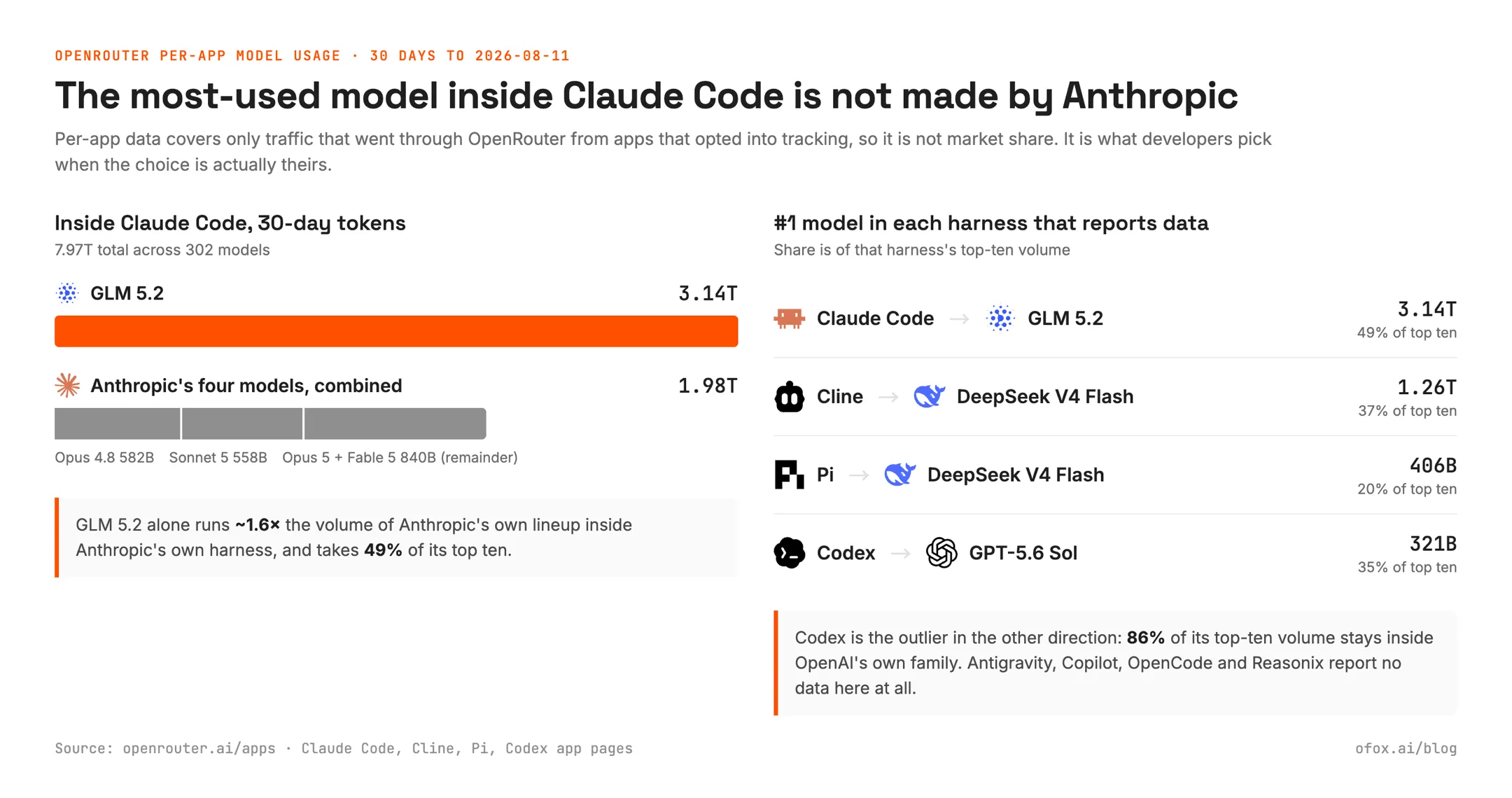
In that older snapshot, GLM 5.2 recorded 3.14T tokens in Claude Code against 1.98T for the four listed Anthropic models combined. Codex’s listed top ten was about 86% OpenAI traffic. Those historical observations cannot establish current preference, model quality or why users chose a model.
Model-pairing examples from the original test period
These are the original model-pairing examples, not a current availability list or a cheapest-model ranking. Their version names and historical usage rationale are retained for the original setup context. Before copying an ID, check the current catalog and verify a real tool round trip. Treat the following “Why” column as the reasoning at the original publication date:
| You already run | Start with | Why |
|---|---|---|
 GLM 5.2 | Claude Code, then OpenCode | The historical route used an Anthropic-compatible interface, and it led that dated usage snapshot. Verify authentication, model selection and tool compatibility rather than assuming a URL change is sufficient. If you are weighing hosted against self-hosting the weights, the hardware maths is separate from the harness choice |
 DeepSeek V4 Flash | Reasonix, then Cline | Reasonix builds its loop around DeepSeek’s prefix cache; Cline is where this model already has the most volume |
| DeepSeek V4 Pro | OpenCode, then Pi | Both let you keep Flash as the default and escalate per task |
 Kimi K3 | Claude Code | Anthropic-compatible endpoint, and it already places in Claude Code’s top ten |
 Qwen 3.8 Max | Codex CLI | One of the few non-OpenAI models exposed over the Responses API, which is what Codex requires |
 MiniMax M3 | Cline, then OpenCode | Plain OpenAI-compatible Chat Completions, no protocol gymnastics |
 GPT-5.6 Sol | Codex CLI | First-party defaults, and the tuning assumptions match |
Codex CLI: OpenAI’s Agent, and the Protocol That Defines It
Where it runs
Terminal only, as a Rust binary from npm i -g @openai/codex, with a separate desktop app on the side. Configuration lives in ~/.codex/config.toml and project instructions in AGENTS.md. Its original OpenRouter rankings described the August dataset, not overall adoption; direct ChatGPT-plan usage is outside that dataset.
What it costs
Bundled with ChatGPT subscriptions, or pay-as-you-go against an API key. The bundling is the reason its OpenRouter footprint understates it.
What extends it
AGENTS.md, MCP servers, and an import command that pulls Claude Code and Cursor configuration across. The original comparison examined its sandbox mechanisms: OS-level isolation using seatbelt on macOS and Landlock plus seccomp on Linux, with approval modes layered on top. If you auto-approve shell commands, that gap is worth real money.
What it locks you into
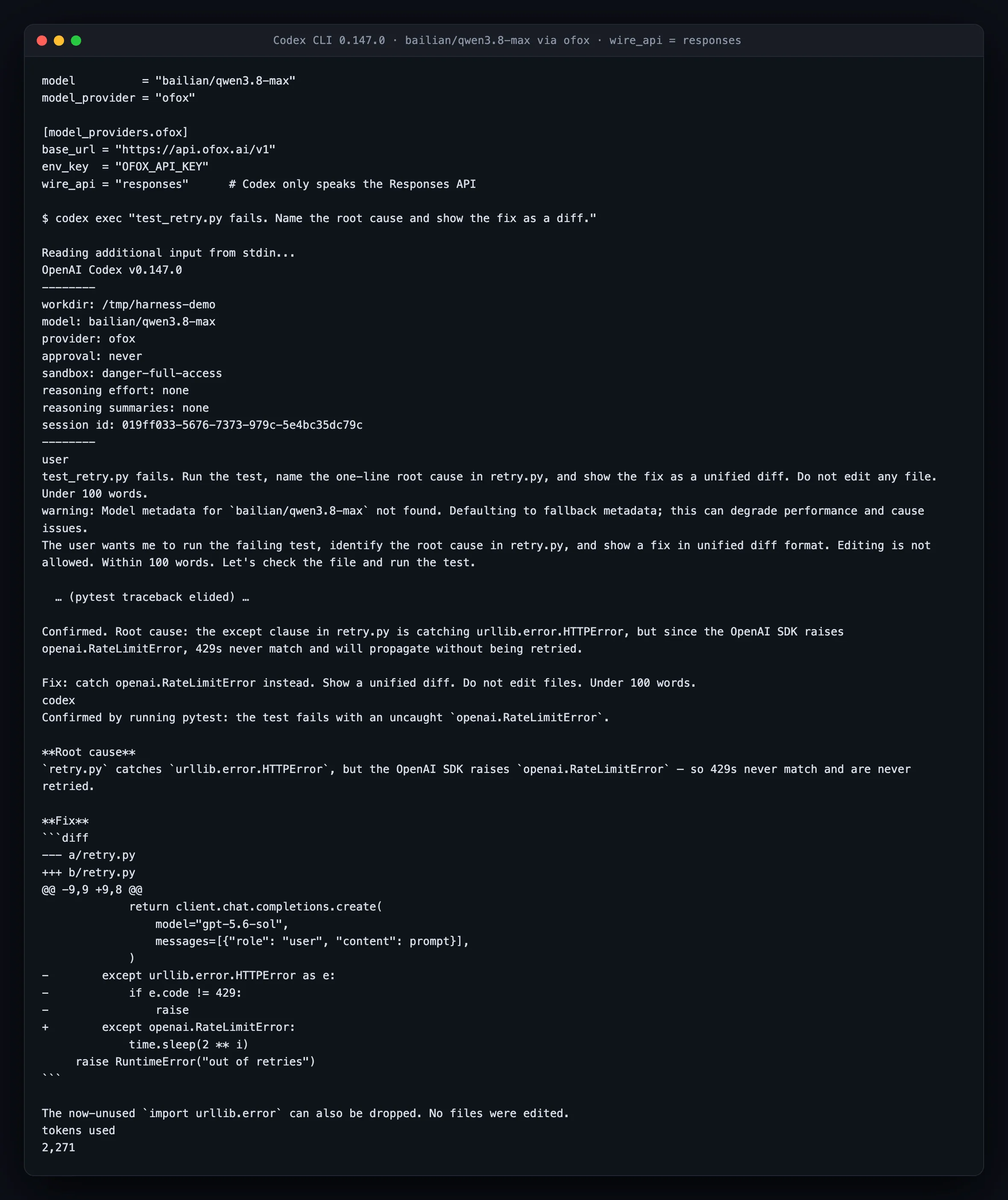
The protocol, not the vendor. The tested Codex build used the OpenAI Responses API; it rejected the removed wire_api = chat option. A gateway therefore has to expose /v1/responses, not just /v1/chat/completions, and support is per model rather than per gateway. Two details trip people up repeatedly: the model ID prefix only applies under a custom model_providers entry, and a gateway advertising a model does not mean that model is reachable over Responses. Setup details are in the ofox Codex integration guide and the model provider page.
“Per model rather than per gateway” is easy to nod along to and hard to picture, so here is what it looked like when we hit it. Codex 0.147.0 with a correct provider block returned Invalid 'input[0].tools[0].description': empty string on every request. We put a logging reverse proxy in front of the gateway and read the body Codex actually sends: it declares its tool namespaces in a developer message, and the functions namespace ships with description: "". Replay that same body against five models and three reject it, one has no Responses provider at all, and one completes. Fill in that single empty string and the previously failing model returns 200. The request was never the gateway’s fault or ours. The client emits a field that some upstreams validate as minLength: 1 and others ignore.
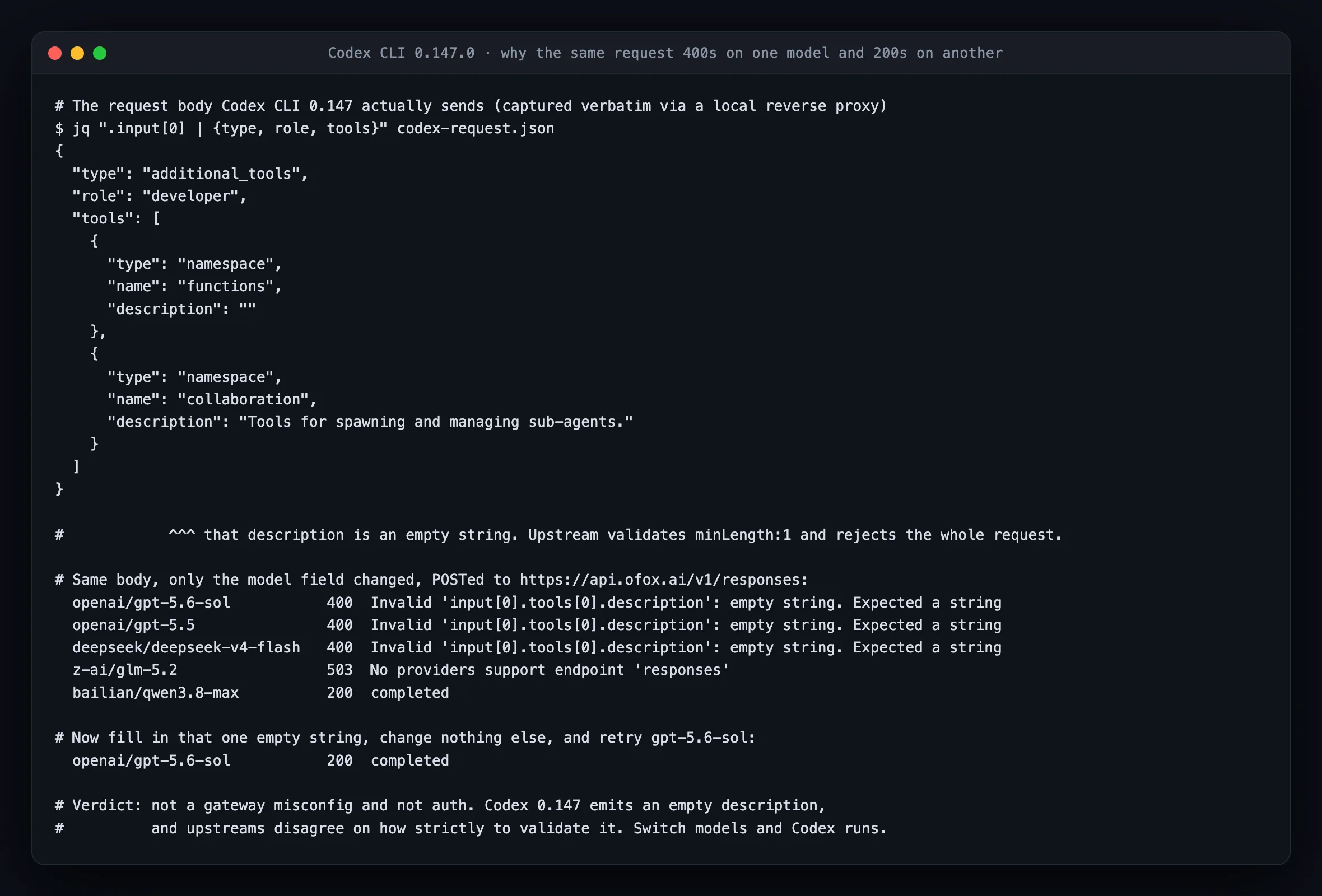
The practical lesson is the one worth carrying into any harness: when a client and a gateway disagree, capture the wire format before you start changing config. We spent one proxy and five minutes on this; guessing at wire_api values would have cost an afternoon and produced the wrong conclusion.
Claude Code: Hooks, Subagents and Model Compatibility
Where it runs
Terminal, installed via npm, with a plugin ecosystem and an IDE bridge. The original August snapshot recorded 7.97T tokens and 302 models on OpenRouter; the updated monthly list above is separate.
What it costs
A Claude subscription, or API billing, or a third-party gateway. The three paths differ enough that “what does Claude Code cost” has no single answer.
What extends it
Hooks fire on tool events, subagents run scoped tasks in their own context, skills package reusable procedures, MCP servers add tools, and CLAUDE.md carries project instructions. If you want the harness to encode your team’s process rather than your own habits, this is the one that supports it.
What it locks you into
Less than the name implies. ANTHROPIC_BASE_URL and ANTHROPIC_AUTH_TOKEN redirect it at any endpoint speaking the Anthropic Messages API, which is why GLM 5.2, Kimi K3, and DeepSeek all appear in its usage data. The historical configuration below used those environment variables; model selection and tool compatibility still need verification:
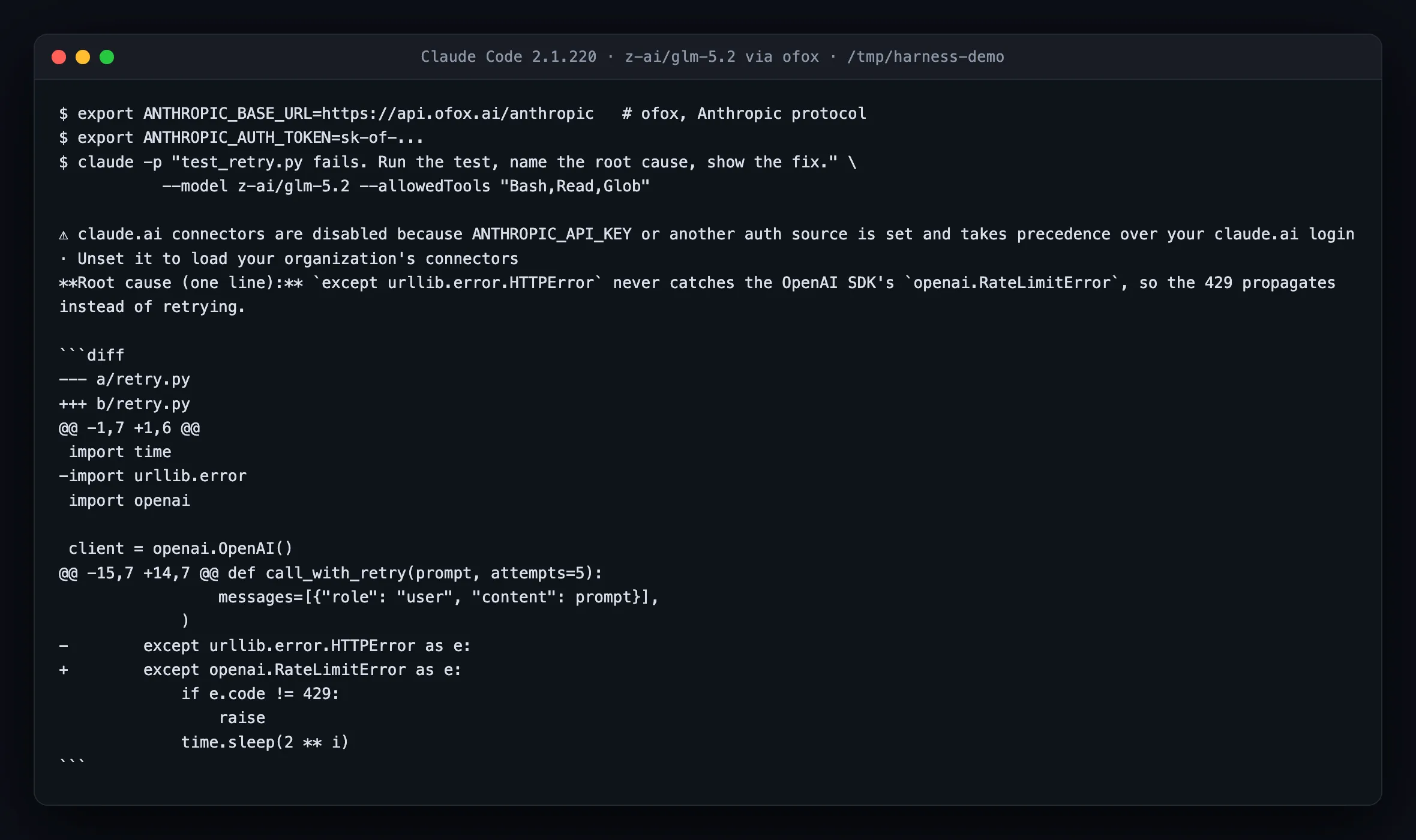
Note what the model does and does not carry over. GLM 5.2 named the exception-type mismatch correctly, but its patch keeps the if e.code != 429 guard, which can never pass: on openai.RateLimitError, .code is a string error code, not the HTTP status. Same harness, same prompt, different model, subtly worse diff. The real lock-in is behavioural: the system prompt, the tool schema, and the context strategy are tuned for Claude models, so a swapped-in model inherits assumptions built for something else. See the ofox Claude Code integration guide and its model provider page for the exact variables. If you are moving the other way, we have a step-by-step migration from Claude Code to Codex.
Google Antigravity: One Brand, Four Surfaces
Where it runs
All over, which is the confusing part. Antigravity now ships as four separate things: Antigravity 2.0, a desktop command centre for running several local agents in parallel; Antigravity CLI, a terminal surface; Antigravity IDE, the full editor; and an SDK for scripting your own agents. It launched in November 2025 as an agent-first IDE and has since expanded outward from that.
Some coverage has reported that Gemini CLI is being shut down and replaced by Antigravity CLI. We went looking for the primary source and could not find one. As of 2026-08-11 that claim is unsupported. The google-gemini/gemini-cli repository is not archived, carries no deprecation notice, and still publishes on its preview, stable, and nightly channels. Neither antigravity.google nor the Google Developers Blog states it. Treat the two as coexisting until Google says otherwise.
What it costs
The August comparison described a free individual tier, a paid organisational tier and higher ceilings on upper Google AI plans. Check current plans before relying on those historical terms. You are buying an allowance, not tokens.
What extends it
The 2.0 manager runs multiple agents concurrently and lets the main agent spin off temporary subagents so parallel work does not pollute the primary context. A built-in browser gives it a way to verify UI changes visually rather than by assertion.
What it locks you into
The original comparison described a built-in model menu. We did not validate a custom-gateway route in the August CLI test. Absence from an OpenRouter app list does not establish whether a product supports another provider.
For that limited check, we installed the CLI (brew install --cask antigravity-cli, version 1.1.12) and its whole option list has no --base-url, no --provider, and no --api-key. Asking it to list models does not get you a list; it gets you a sign-in wall.
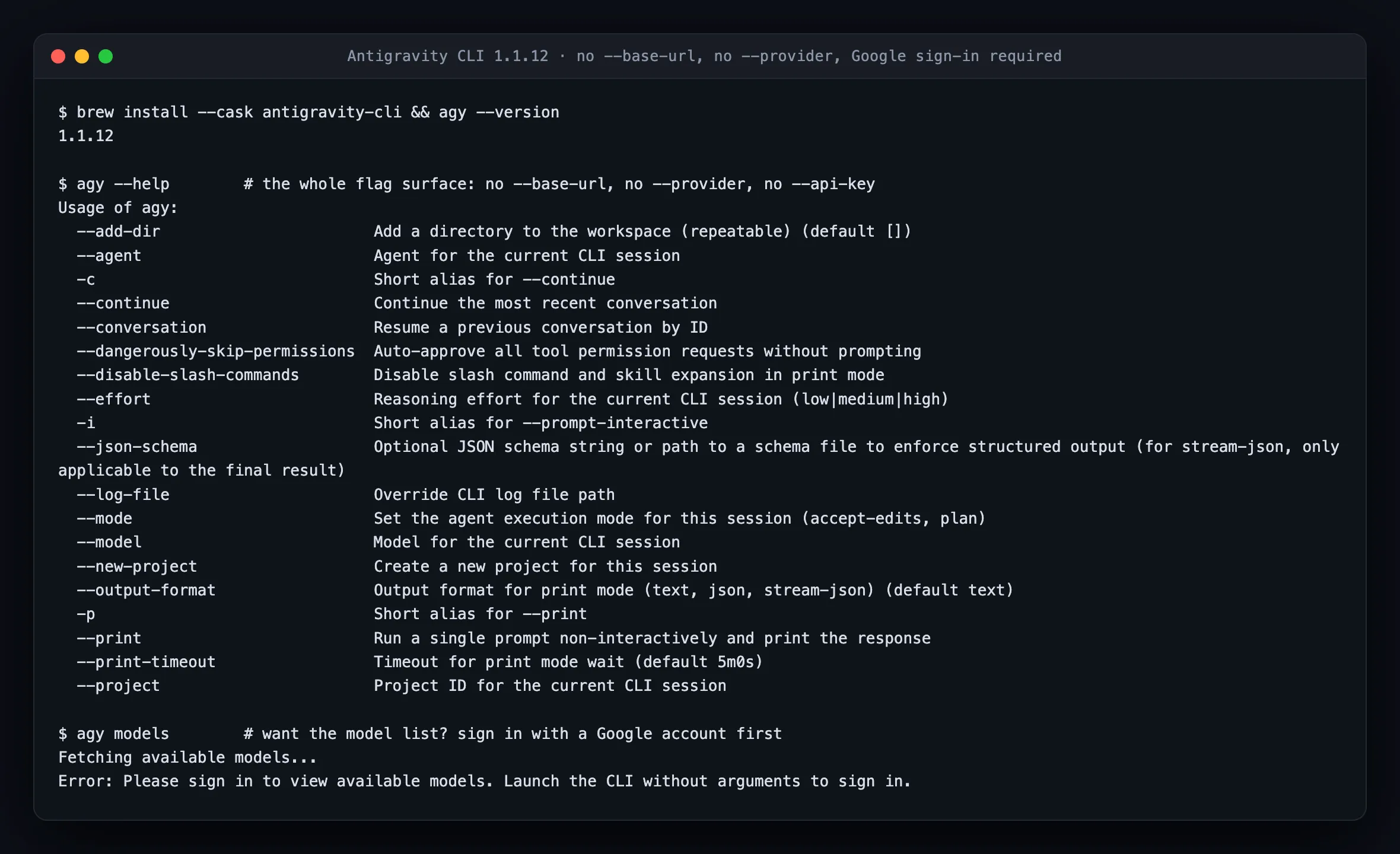
This records the August CLI 1.1.12 test limitation. Absence of a command-line flag alone does not rule out every configuration mechanism or establish current product behavior. Copilot and Cursor were also excluded from the equivalent execution test; their current key support is discussed below.
GitHub Copilot: The Default Everyone Has, Billed by Credits
Where it runs
Everywhere GitHub reaches: VS Code and other IDEs, the Copilot CLI in the terminal, a cloud coding agent that opens pull requests, and code review inside GitHub itself. Breadth is the product.
What it costs
Check Copilot’s current plans for subscription allowances and overage rules. With local BYOK, the provider’s bill is separate from included Copilot usage. Do not use the original August plan figures as an October quotation.
What extends it
MCP servers, custom instructions, and repository-level configuration, plus auto model selection in the CLI that routes by task type.
What it locks you into
October 20 correction: GitHub’s current BYOK documentation lists local key support across VS Code, JetBrains, Xcode, Copilot CLI, the Copilot app and SDK. Local keys stay client-side; organization policy may disable local BYOK in IDEs. Enterprise BYOK is a separate public-preview mechanism: owners configure custom models centrally, with license and internet requirements. A third-party VS Code extension is therefore not the only route. Check the exact client’s supported provider and endpoint configuration; this documentation does not prove an Ofox endpoint or every tool works on every Copilot surface. We did not perform a new Copilot execution test.
Cursor: Editor Features and Provider-Key Limits
Where it runs
As a standalone editor. The original August OpenRouter snapshot placed it at #11 with 471B tokens over 30 days. That gateway-specific count is historical and cannot establish overall adoption or the amount of traffic handled outside OpenRouter.
What it costs
A per-seat subscription with usage tiers on top.
What extends it
Rules files, MCP servers, and a strong multi-file editing loop. Its Tab model is the one feature people most often say they cannot replace, and it is a genuine reason to keep the editor even if the agent work happens elsewhere.
What it locks you into
October 20 documentation check: Cursor’s API-key guide supports keys for named providers and limits custom keys to supported chat models; Tab still uses Cursor’s built-in models. Provider model charges and any Cursor plan charges must be checked separately, particularly for Teams and Enterprise. Do not infer that a supported provider key means an arbitrary OpenAI-compatible gateway works, or that every agent feature has been tested. This article has not run a new Cursor gateway test. The earlier Ofox compatibility notice should not be treated as proof of every current Cursor restriction.
Cline: Provider Choice and a Plan-Then-Act Loop
Where it runs
As an extension inside VS Code and JetBrains. The original August OpenRouter snapshot placed it at #4 globally and #2 among IDE extensions. Those ranks are historical, not its October position.
What it costs
The extension is free; API usage is billed separately. Token popularity alone does not establish why users chose a provider or what their tasks cost.
What extends it
A plan-then-act split, a task board for managing parallel work, MCP servers, and browser automation for verifying front-end changes. The planning surface is genuinely stronger than most terminal agents offer.
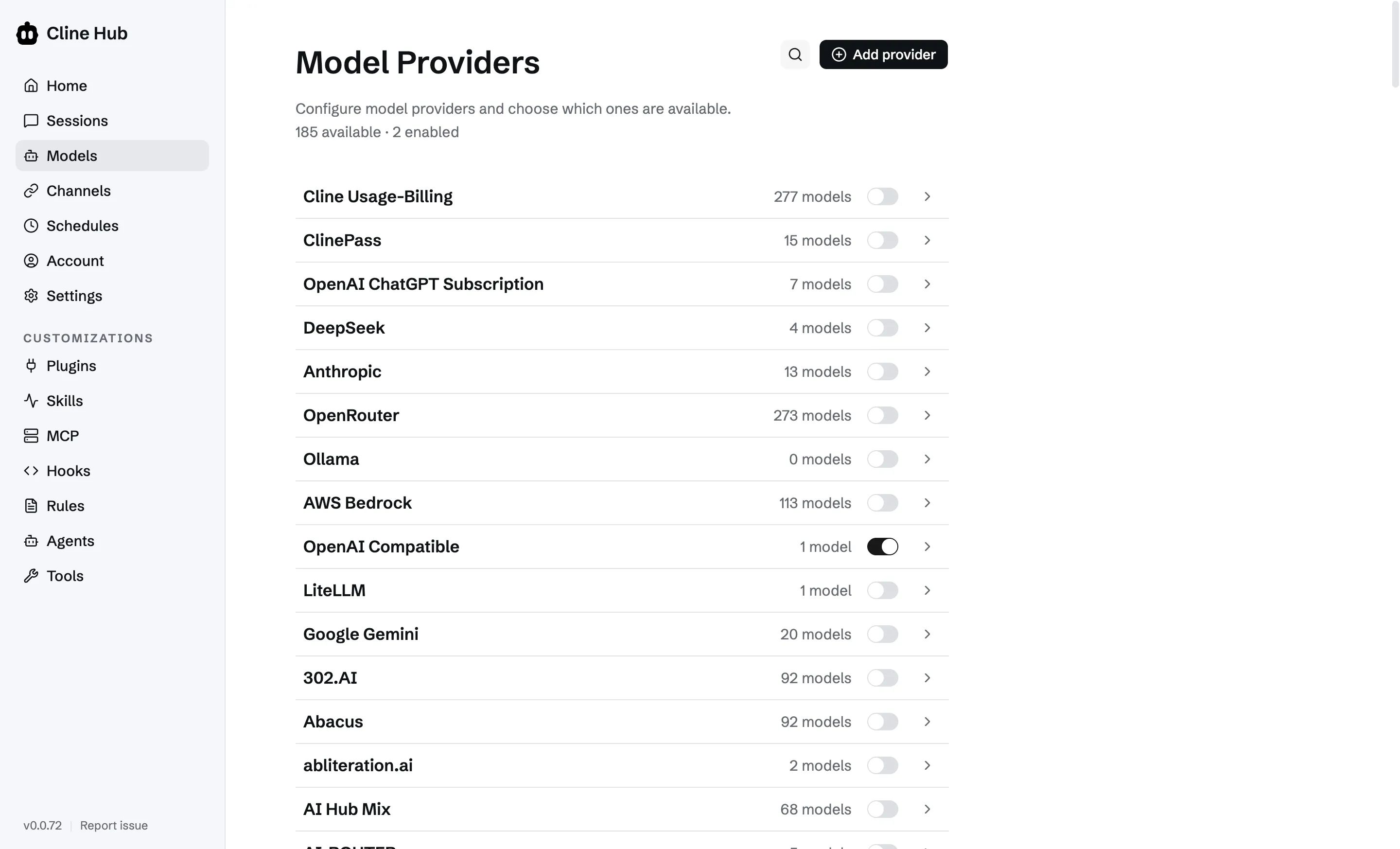
The original test recorded 185 providers in the list, including an explicit “OpenAI Compatible” entry. That is a dated UI observation, not a current count or a verified compatibility result for every provider.
What it locks you into
Cline exposes OpenAI-compatible and Anthropic-compatible provider settings, but the endpoint, model and tool schema still need testing. DeepSeek V4 Flash accounted for 37% of its top-ten traffic in the August snapshot; that does not explain the users’ reasons. The following historical run used cline auth and one tested gateway/model pair:
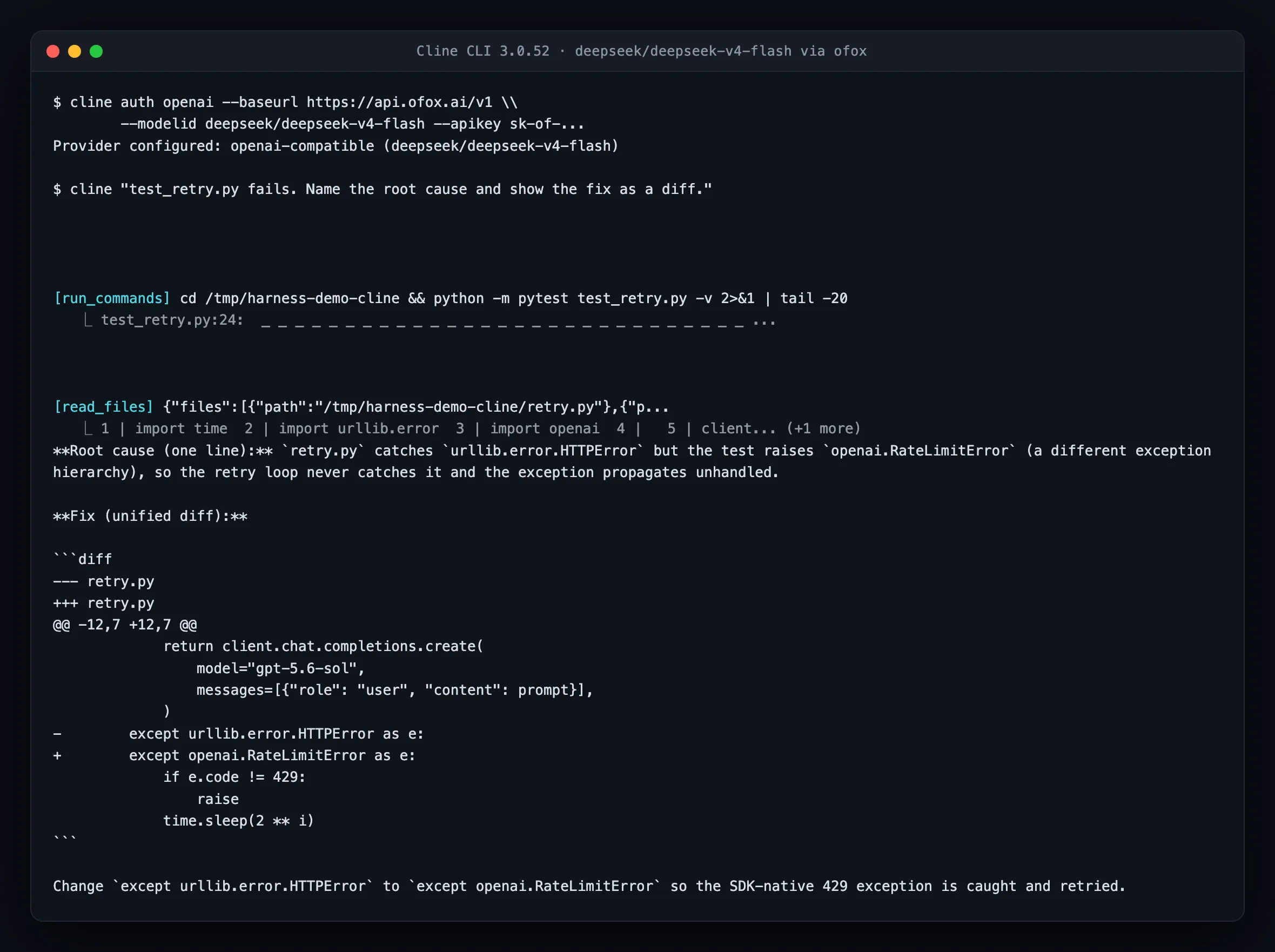
One loop-reliability example comes from the r/AI_Agents thread: a user described jobs stalling on malformed tool calls and moving to a fork that handled them more gracefully. That is a single report and worth weighing as one, but it points at the axis that matters, which is the loop rather than the model. We hit one adjacent rough edge ourselves: pointing the CLI at a reasoning-capable Claude model over the OpenAI-compatible path failed with an internal text part ... _reasoning_0 not found error, while non-reasoning models on the same endpoint ran clean. Setup is in the ofox Cline integration guide.
OpenCode: Model-Agnostic by Construction
Where it runs
Terminal-first with a desktop app and editor surfaces, installed as opencode-ai from npm, MIT licensed, with AGENTS.md for project instructions. It does not appear in OpenRouter’s app rankings, which reflects tracking opt-in rather than absence of users.
What it costs
Free and open source. You pay only for tokens.
What extends it
AGENTS.md, MCP servers, and a provider layer that reaches every provider listed on models.dev, 183 of them when we checked on 2026-08-11, with mid-session switching. ofox ships as a built-in provider, so the setup is an environment variable rather than a JSON block.
What it locks you into
Nothing structural, which is the whole design. On the same failing-test task, it was the one that showed its work most completely, running the suite, printing the traceback, then reading the source before answering:
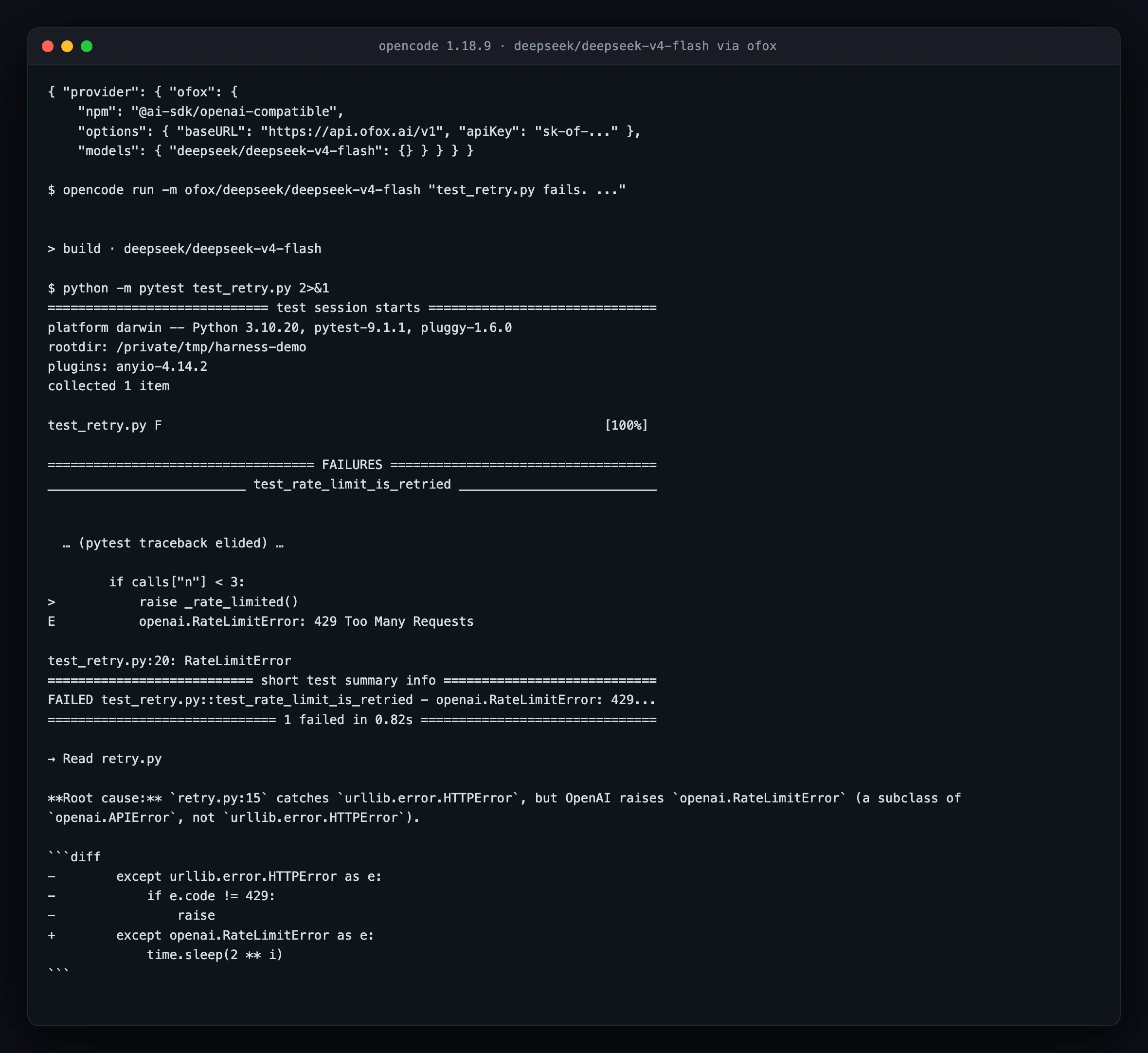
The tradeoff is that a harness with no default vendor also has no vendor tuning its prompts for you, so getting the best out of it takes more configuration than Claude Code or Codex asks for. The ofox OpenCode integration guide covers the provider setup, and we compared the two terminal agents head to head in OpenCode vs Codex CLI.
Reasonix: Community-Built, DeepSeek-Tuned, Cache-First
Where it runs
Four places off one local engine: a CLI and TUI, a desktop app, a browser surface, and a VS Code extension that talks to the same backend over ACP. It ships as a single static Go binary with CGO_ENABLED=0, installed by npm i -g reasonix on any OS or brew install esengine/reasonix/reasonix on macOS. The original test used version 1.23.0, released on 2026-08-10; that release alone does not establish its current maintenance status.
The name needs a correction before anything else. Reasonix is not a DeepSeek product. It is a community project at github.com/esengine/DeepSeek-Reasonix, MIT licensed, with its own site at reasonix.io. DeepSeek’s official documentation lists Claude Code, GitHub Copilot, and OpenCode as documented agent integrations and does not mention Reasonix. The third-party site carrying most of its coverage states on the page that it is independent and unaffiliated. The tool is real and interesting; the DeepSeek branding on it is not official.
What it costs
Free and open source, plus whatever your model costs. The design goal is that the second number stays small.
What extends it
MCP servers contribute tools and prompts, and Extension Protocol v1 sidecars go further by intercepting runtime events, adding providers, and shipping versioned plugin packages. Everything is declared in a single reasonix.toml with no hardcoded models. It also ships the safety furniture a long unattended run needs and Pi deliberately omits: plan mode, a permission layer, a workspace sandbox, and per-turn checkpoints you can read and undo. Its documented design includes running an executor model and a planner model in separate cache-stable sessions; this comparison does not establish exclusivity.
What it locks you into
Nothing at the protocol level: any OpenAI-compatible endpoint is one config entry, and reasonix.toml is the whole of it:
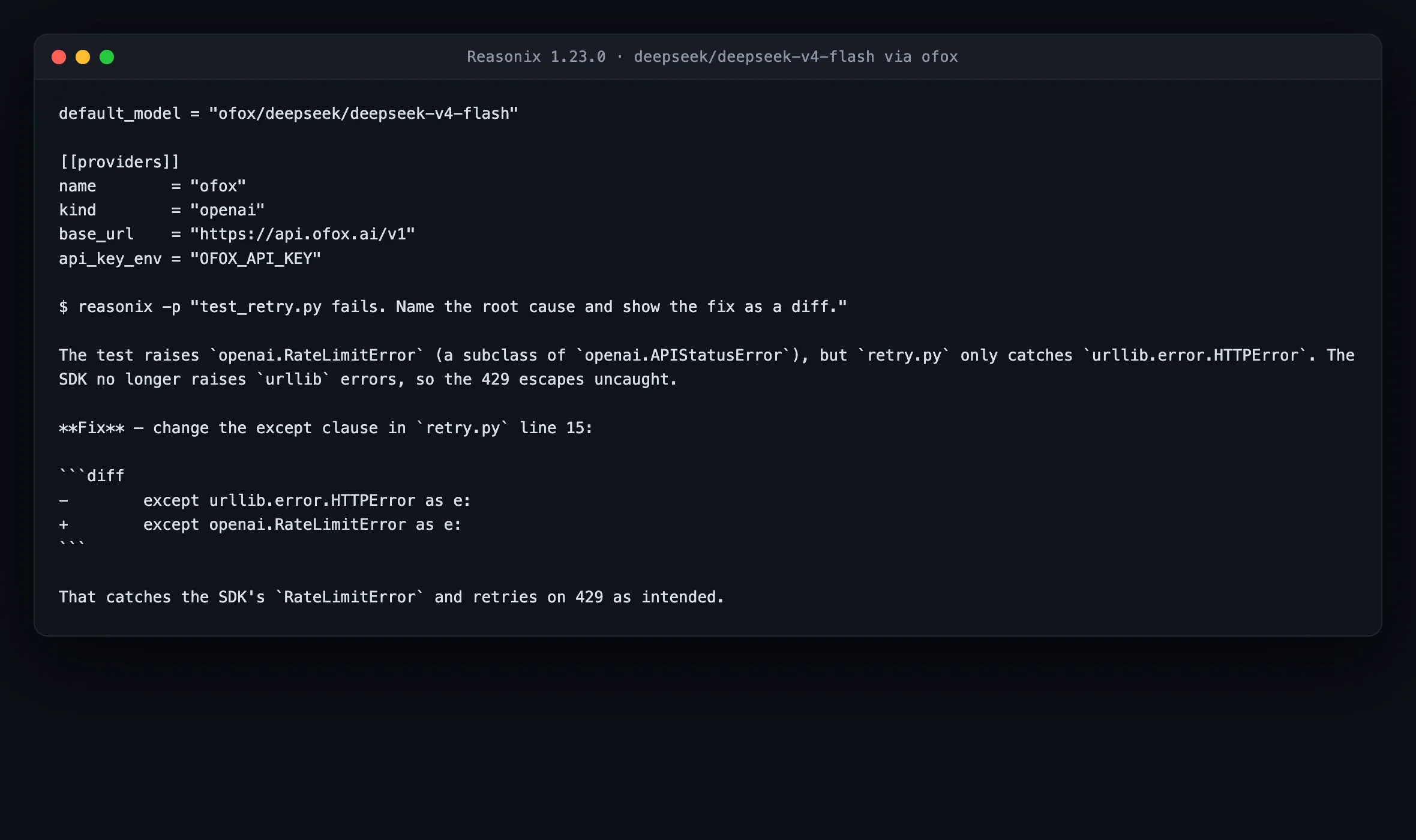
The interesting bias is in the loop itself, which is engineered around DeepSeek’s prefix-cache behaviour so a long-running session keeps hitting cache instead of re-paying for context. That is a real differentiator if you leave an agent running for hours, and close to irrelevant if you work in short bursts. Because DeepSeek’s cache matches on complete units rather than byte-for-byte prefixes, the savings arrive later in a session than people expect; plan around the shape of your work, not the headline cache rate.
Pi: A Minimal Core With Extensions and Built-In MCP
Where it runs
Terminal, and also as print/JSON output, an RPC service, and an embeddable SDK. Install with npm i -g @earendil-works/pi-coding-agent; version 0.84.1 landed on 2026-08-07. That version and the 2.79T OpenRouter figure belong to the original August comparison. Pi remains MIT licensed; consult its current installation instructions for a new setup.
What it costs
Free and open source.
What extends it
October 20 correction: Pi’s current site documents extensions, skills, prompt templates and packages, plus built-in MCP and Codemode. The old “no MCP” description is no longer correct. Subagents, permission popups and plan mode remain distinct customization choices; minimal defaults do not mean the system has no extension or context-management features. This is a documentation update, not a retest of the historical Pi 0.84.1 screenshot.
What it locks you into
Pi documents 15+ providers, mid-session model switching with /model, and custom providers through models.json or extensions. Provider choice does not remove protocol or tool-compatibility checks. The following is the original Pi 0.84.1 configuration screenshot:
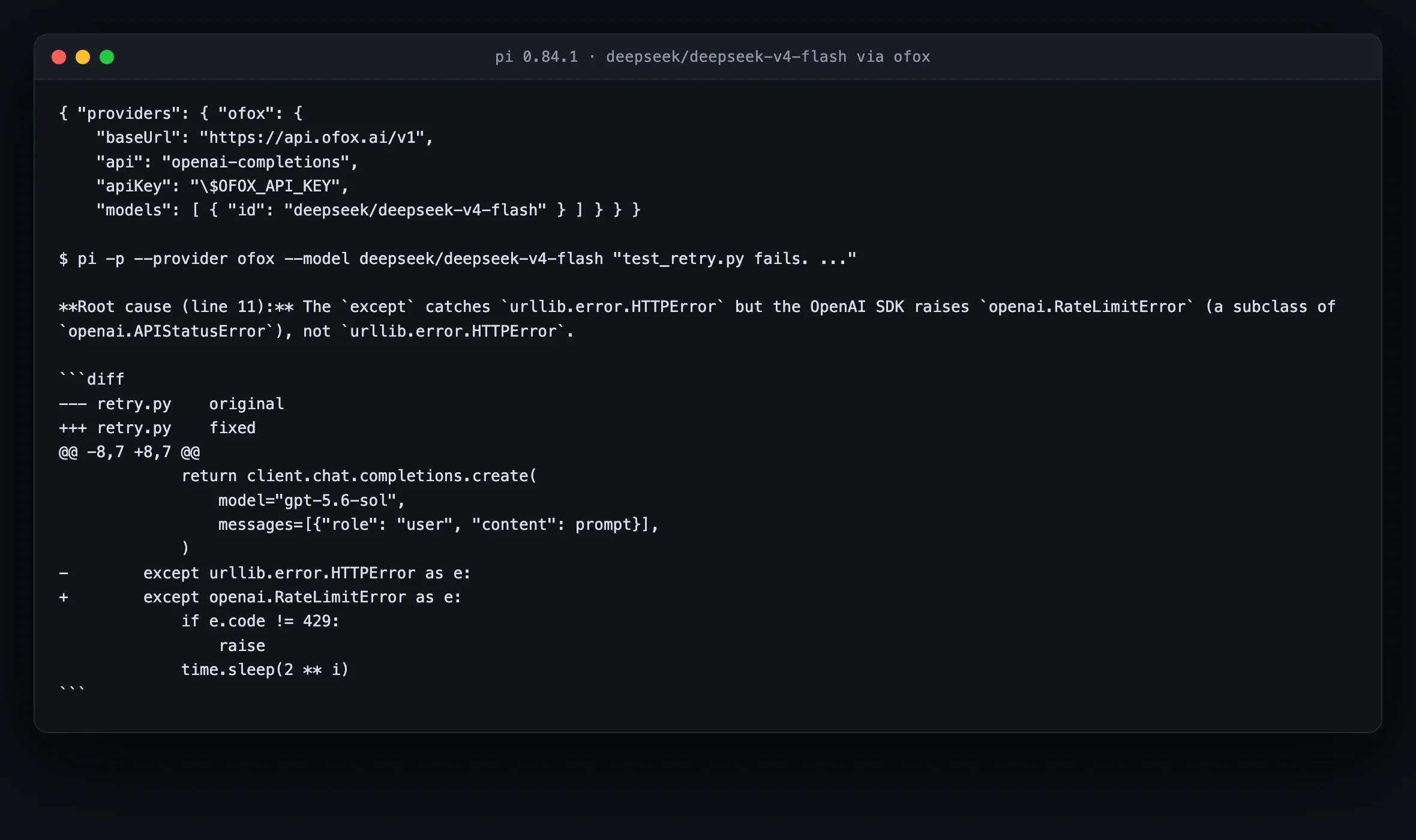 One caveat deserves flagging because the project documents it openly: Pi has no built-in permission system for filesystem, process, network, or credential access, so sandboxing is your job. Run it in a container if you are giving it anything sensitive. A community token-usage report is not a controlled cost comparison; measure your own task and retry usage before drawing a cost conclusion.
Other AI Coding Agents Worth Knowing
The rankings in this additional list belong to the original August snapshot. These did not get full sections either because they occupy a narrower slice or because we could not put them through the same hands-on pass.
| Tool | Shape | Notable for | ofox docs |
|---|---|---|---|
 Kilo Code | VS Code, JetBrains, CLI | #3 coding agent on OpenRouter, ahead of Cline | No |
 Roo Code | VS Code extension | Multiple specialised agent roles in one workspace | No |
 Aider | Terminal | Repo maps, a concise structural view of the codebase sent before each edit, which reduces wrong-file edits | Via others |
 Zed | Editor | Fast native editor with an agent panel; #14 in the coding ranking | Yes |
 OpenHands | Terminal, cloud | Open-source autonomous agent with browser and API access | No |
 goose | Terminal | Block’s open-source agent, extension-driven | No |
| Qwen Code | Terminal | Alibaba’s CLI workflow tool | No |
 Crush | Terminal | Charm’s TUI agent, strong terminal ergonomics | No |
| DeepSeek Harness (dsh) | Terminal, web UI | DeepSeek’s own launcher, still pre-1.0; the bundles are co-versioned by the launcher, so which release you are on matters more than with most agents | No |
 OpenClaw | Messaging-driven | Runs commands from chat apps; #5 coding agent by volume | Yes |
   Windsurf / Devin / Factory | IDE and cloud | Commercial autonomous agents, subscription-gated | No |
Are Antigravity and GitHub Copilot the Same Thing?
They overlap as coding assistants, but compare the exact surface rather than treating either brand as one fixed client. The original Antigravity test covered CLI 1.1.12 and its sign-in requirement. Copilot spans IDE, CLI and GitHub workflows; its current local BYOK option also changes the assumption that all model usage must draw from a bundled allowance.
For a real choice, check repository access, execution location, available verification tools, approval controls and billing on the client you will use. This article has not rerun an equivalent task on current Antigravity and Copilot versions, so it cannot establish a current performance or cost winner.
Which Harnesses Work Remotely or Async?
Terminal-native tools are the ones you can put on a server. Codex CLI, Claude Code, OpenCode, Reasonix, and Pi all run headless over SSH, and Pi goes furthest by exposing print/JSON, RPC, and SDK modes designed for exactly that. The original comparison covered Cursor’s editor surface; it did not establish the limits of all current remote or CLI offerings. Copilot goes furthest in the other direction, with a cloud agent that accepts an issue and returns a pull request without a machine of yours being involved. Antigravity 2.0 runs several agents in parallel but they are local agents in a local window.
Cline is the surprise in this column. The extension needs an editor, but the CLI does not: it starts a local hub daemon and a browser dashboard that tracks connected clients and running sessions, which makes it viable on a box you have SSH’d into.
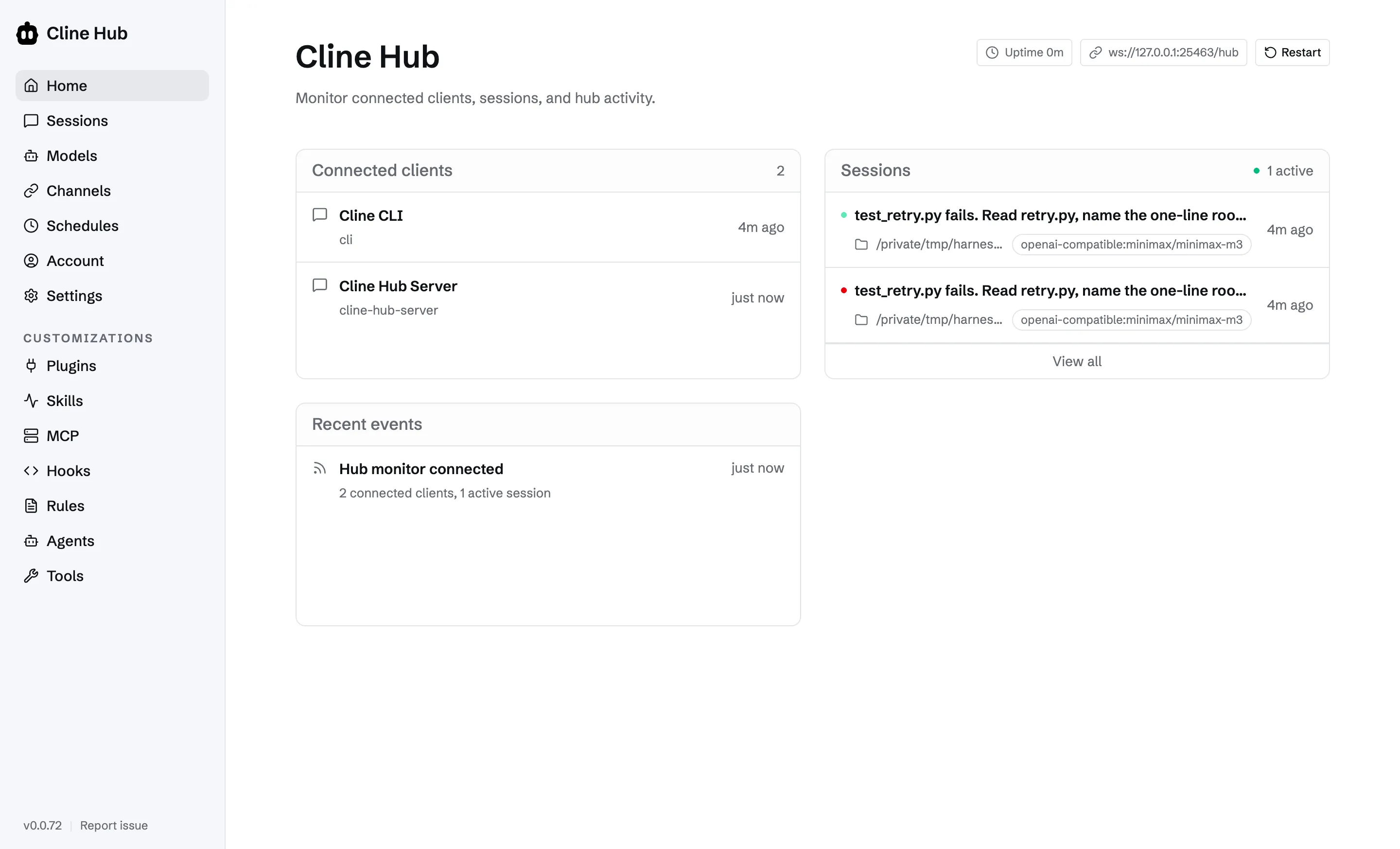
If unattended, long-running work is the goal, the shortlist is short: a terminal harness plus a model with stable caching, which is precisely the niche Reasonix was built for.
What Does a Month of Agent Coding Actually Cost?
A monthly total depends on the accepted work and its failed attempts. Record uncached input, cache reads/writes, output tokens, retries, external-tool charges and any seat or platform fees separately. Use the provider’s actual billing units and avoid counting cached tokens twice.
Task cost = model usage billed across all attempts + billed external tools + any attributable platform charges. Retries are included in those usage totals, not added again as a separate fee. For a monthly budget, add fixed subscription fees to variable usage without adding included usage again. Rates and cache eligibility depend on the exact model and route; this update does not quote current Ofox rates or promise a saving.
Compare the same repository revision and acceptance test. Log model ID, harness version, route, token categories, duration, failed attempts and the final test result. A cheap run that fails acceptance is not comparable to a completed task. Repeated runs are needed before claiming one harness is cheaper; OpenRouter token totals cannot answer that question.
When Is Each One the Right Call?
Every tool here wins somewhere. In order:
- Codex CLI when you live in the OpenAI stack and auto-approve shell commands. Its original review examined OS-level isolation primitives, seatbelt on macOS and Landlock plus seccomp on Linux.
- Claude Code when you want the harness to encode team process. Evaluate its hooks, skills and subagents against your required process.
- Antigravity when its supported parallel-agent and visual-verification workflow fits your task; verify current plan limits.
- GitHub Copilot when the work happens in pull requests and reviews rather than in an editor session, and when everyone on the team already has a seat.
- Cursor when editing speed matters most. Evaluate its Tab workflow and the model access available in your plan.
- Cline when you want plan-then-act discipline inside the IDE with a cheap model behind it.
- OpenCode when model freedom is the requirement and you are willing to configure.
- Reasonix when sessions run for hours and cache economics dominate your bill.
- Pi when you have strong opinions about the loop and want a foundation rather than a product.
Can You Run More Than One?
Yes. The r/AI_Agents thread reads less like a search for one winner than a description of a portfolio: an editor for fast edits, an IDE agent for local context, a terminal agent for multi-file work with tests. One commenter recommended keeping those three lanes explicitly separate and testing any new tool on the same three tasks, a bug fix, a small feature, and a refactor with tests, then keeping whichever produced the smallest clean diff with the fewest manual nudges.
That is a practical task-specific evaluation, not a substitute for every benchmark. Our own four-tool comparison of Claude Code, Codex, Gemini CLI, and Cursor and the terminal-agent shootout both approached the category that way, one tool at a time against the same work.
The reason more people do not run that test is not that it is hard. It is that running three harnesses means configuring three sets of credentials.
How Do You Point All of Them at the Same Key?
Which is the practical gap underneath this entire comparison. Every tool here that lets you choose a model expects its own credentials, in its own format, in its own config file. Claude Code wants ANTHROPIC_BASE_URL and ANTHROPIC_AUTH_TOKEN. Codex wants a model_providers block in TOML with wire_api = "responses". Cline wants provider settings in the extension UI. OpenCode wants a provider entry, Reasonix a reasonix.toml stanza, Pi its own provider config. Several tools can require separate configuration even when they use the same provider account.
The gap is real and it is not any one tool’s fault. It is what happens when a category standardises on two wire protocols and nothing else.
A gateway can centralize credentials and billing, but integration still depends on protocol and tool behavior. Ofox’s integration documentation is a setup starting point; validate the model ID, endpoint, tool call and test result on your exact client. A shared key does not mean shared feature support or unlimited rate capacity.
Copilot’s local BYOK is no longer accurately described as Individual-seat Chat only. Cursor’s documentation distinguishes supported provider chat keys from its built-in Tab model. Neither document validates every Ofox route. The original Antigravity test found no key-only setup in the tested CLI; it is not a new test of the current release.
Keep credentials out of repositories and screenshots. Start with a synthetic task, bounded spend and explicit acceptance criteria before connecting a production repository.
Verdict: Pick the Loop, Then Pick the Model
Choose the harness for the work you need to control: an IDE interaction, a terminal loop, a custom tool integration or a remote task. Choose the model only after confirming the route, permissions and required tool behavior. Neither the historical test nor OpenRouter’s current usage lists establish a universal winner.
For an API-based setup, start with one synthetic repository task, an explicit budget and a test that can fail. Keep the exact harness version, model ID, protocol, expected diff and observed test result in your record. A successful credential test or plausible patch is not acceptance. For a worked example of that distinction outside coding, our n8n own-key workflow checks both the tool observation and final output. No monthly cost saving is promised here.
References
- OpenRouter coding agent rankings
- OpenRouter app page: Claude Code
- OpenRouter app page: Codex
- OpenRouter app page: Cline
- OpenRouter app page: pi
- GitHub Copilot plans and pricing
- Google Antigravity
- google-gemini/gemini-cli repository
- openai/codex repository
- cline/cline repository
- esengine/DeepSeek-Reasonix repository
- pi.dev
- DeepSeek API documentation
- r/AI_Agents: What AI harness for coding?
- ofox integration docs
For the September 10 managed-service launch, read our OpenAI Agents API analysis. It explains how the hosted Codex harness differs from running a coding tool yourself, including sandbox responsibilities and billing.
Frequently Asked Questions
- What is an AI coding agent harness?
- A harness is the program that wraps a model and turns it into an agent. The model generates tokens. The harness decides which files get read into context, which tools the model may call, whether a shell command needs approval, what happens when a test fails, and whether a session can resume after an interruption. Claude Code, Codex CLI, Cline, and OpenCode are harnesses. GLM 5.2, GPT-5.6, and DeepSeek V4 are models. You pick both, and the pairing matters more than either one alone.
- Can I run a non-Anthropic model in Claude Code?
- A compatible gateway can provide a route using ANTHROPIC_BASE_URL and ANTHROPIC_AUTH_TOKEN, but protocol and tool compatibility must be tested. GLM 5.2 led the August 11 OpenRouter snapshot; that is historical. The October 20 monthly list is led by Claude Opus 5.5 and is not overall market share.
- Is Reasonix made by DeepSeek?
- No. Reasonix is a community project at github.com/esengine/DeepSeek-Reasonix, MIT licensed, published to npm as reasonix. Its own site is reasonix.io. DeepSeek's official docs list Claude Code, GitHub Copilot, and OpenCode as documented agent integrations and do not mention Reasonix. The deepseek.ai domain that carries a Reasonix write-up states on the page that it is an independent site not affiliated with DeepSeek.
- Has Gemini CLI been shut down or replaced by Antigravity CLI?
- No. As of 2026-08-11 the google-gemini/gemini-cli repository is not archived, carries no deprecation notice, and still ships on its preview, stable, and nightly release channels. Antigravity does now include a CLI surface of its own, and some coverage has read that as a replacement, but neither antigravity.google nor the Google Developers Blog says Gemini CLI is going away.
- Which harness is cheapest to run?
- There is no cheapest harness established by this comparison. Total cost depends on the plan, model rates, input/output/cache usage, retries and external tools. Token popularity is not a cost measurement. Compare the same accepted task and include failed billable attempts.
- Do I need a separate API key for every coding agent?
- Some clients can share a provider credential, but a key alone does not establish protocol or tool support. Copilot now documents local BYOK across several clients and a separate enterprise mechanism. Cursor supports provider keys for chat models, while Tab remains on its built-in models. Verify the exact client and provider before reusing a key.
- Which harness has the best extensibility?
- The right extension surface depends on the task. Claude Code offers hooks, subagents, skills and MCP. Pi now documents extensions, skills, packages, built-in MCP and Codemode; its former no-MCP description is obsolete. Check built-in capabilities separately from extensions, permissions and sandbox responsibilities.